1987
Issue 29 1987
Main Cover
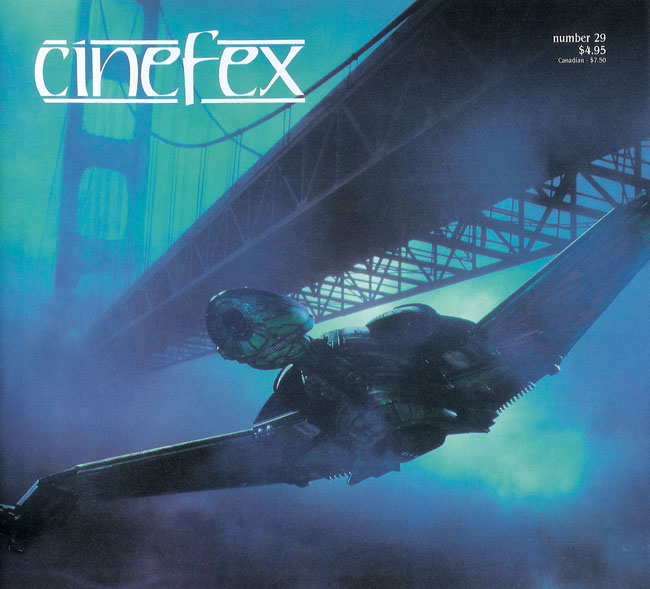
<FONT COLOR='#ff0000'>Star Trek IV: The Voyage Home: Humpback to the Future</FONT>: From deep space to deep waters, Star Trek IV: The Voyage Home engages the ever-stalwart crew of the U.S.S. Enterprise in a humanistic quest that begins and ends in the twenty-third century but unfolds for the most part in modern-day San Francisco. Along with its customary quota of spaceships and transporter beams, the latest adventure called for a representation of the planet Vulcan, a unique time travel effect, major storm sequences on earth and a totally convincing simulation of two humpback whales. Article by Jody Duncan Shay<BR>
<FONT COLOR='#ff0000'>King Kong Lives: After the Fall</FONT>: Forty-three years after toppling from the Empire State Building, King Kong was called upon to take an even greater tumble from the World Trade Center. Now, another decade later, the long-suffering ape has been resurrected once more for King Kong Lives - again as an ape-suited actor augmented by full-size mechanical artifacts. Discussing their work on the film are creature creator Carlo Rambaldi, production designer Peter Murton, visual effects supervisor Barry Nolan, and model shop supervisors David Jones and Dave Kelsey. Article by Janine Pourroy<BR>
<FONT COLOR='#ff0000'>Top Gun: Sky Wars</FONT>: Even with full support from the U.S. Navy, the producers of Top Gun realized that some of the sequences planned for their film would have to rely heavily on special effects. To create crash scenes and aerial explosions that would simulate actual air-to-air photography and intercut convincingly with live-action flight footage, visual effects supervisor Gary Gutierrez and his USFX organization launched an intensive campaign employing large-scale miniatures, outdoor settings and innovative pyrotechnics. Article by Ed Martinez
<FONT COLOR='#ff0000'>King Kong Lives: After the Fall</FONT>: Forty-three years after toppling from the Empire State Building, King Kong was called upon to take an even greater tumble from the World Trade Center. Now, another decade later, the long-suffering ape has been resurrected once more for King Kong Lives - again as an ape-suited actor augmented by full-size mechanical artifacts. Discussing their work on the film are creature creator Carlo Rambaldi, production designer Peter Murton, visual effects supervisor Barry Nolan, and model shop supervisors David Jones and Dave Kelsey. Article by Janine Pourroy<BR>
<FONT COLOR='#ff0000'>Top Gun: Sky Wars</FONT>: Even with full support from the U.S. Navy, the producers of Top Gun realized that some of the sequences planned for their film would have to rely heavily on special effects. To create crash scenes and aerial explosions that would simulate actual air-to-air photography and intercut convincingly with live-action flight footage, visual effects supervisor Gary Gutierrez and his USFX organization launched an intensive campaign employing large-scale miniatures, outdoor settings and innovative pyrotechnics. Article by Ed Martinez
Issue 30 1987
Main Cover
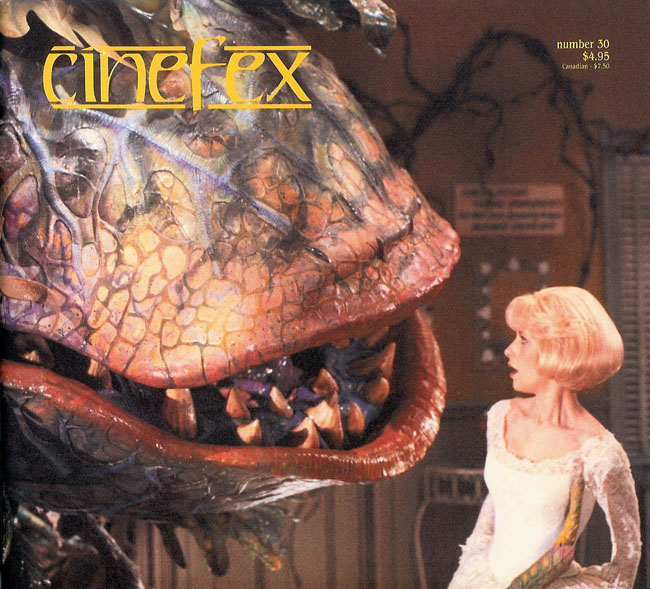
<FONT COLOR='#ff0000'>Little Shop of Horrors: The Care and Feeding of Audrey II</FONT>: For someone with Lyle Conway's background, Little Shop of Horrors was a dream come true - and a nightmare. Enlisted by director Frank Oz to design and create a believable plant character that could hold its own in a multimillion dollar musical comedy, Conway and a crew of forty animatronics specialists rose to the challenge by producing six fully-articulated versions of Audrey II ranging in size from four-and-a-half inches to twelve-and-a-half feet - and then taught the largest three how to speak and sing. Article by Jody Duncan<BR>
<FONT COLOR='#ff0000'>The Gate: A Question of Perspective</FONT>: Seeking major league effects on a minor league budget, producer John Kemeny and director Tibor Takacs turned to effects designer Randall William Cook for their supernatural thriller The Gate. Working with a hand-picked team of professionals, Cook orchestrated a wide range of mystifying effects - including a giant stop-motion demon and a swarm of devilish minions rendered tiny by some ingenious illusory techniques seldom employed in recent years. Article by Adam Eisenberg<BR>
<FONT COLOR='#ff0000'>The Golden Ghild: Of Daggers and Demons</FONT>: For Industrial Light & Magic, The Golden Child was business as usual - winged demons, slithering snake women, even dancing Pepsi cans. But merging these fantasy elements into a gritty urban street comedy starring Eddie Murphy was a major stylistic challenge. Rising to the occasion was a team of software engineers and puppet animators who managed to blur the line between real and unreal by employing a prototype field motion control system to convincingly incorporate stop-motion figures into hand-held action scenes. Article by Paul Mandell
<FONT COLOR='#ff0000'>The Gate: A Question of Perspective</FONT>: Seeking major league effects on a minor league budget, producer John Kemeny and director Tibor Takacs turned to effects designer Randall William Cook for their supernatural thriller The Gate. Working with a hand-picked team of professionals, Cook orchestrated a wide range of mystifying effects - including a giant stop-motion demon and a swarm of devilish minions rendered tiny by some ingenious illusory techniques seldom employed in recent years. Article by Adam Eisenberg<BR>
<FONT COLOR='#ff0000'>The Golden Ghild: Of Daggers and Demons</FONT>: For Industrial Light & Magic, The Golden Child was business as usual - winged demons, slithering snake women, even dancing Pepsi cans. But merging these fantasy elements into a gritty urban street comedy starring Eddie Murphy was a major stylistic challenge. Rising to the occasion was a team of software engineers and puppet animators who managed to blur the line between real and unreal by employing a prototype field motion control system to convincingly incorporate stop-motion figures into hand-held action scenes. Article by Paul Mandell
Issue 31 1987
Main Cover
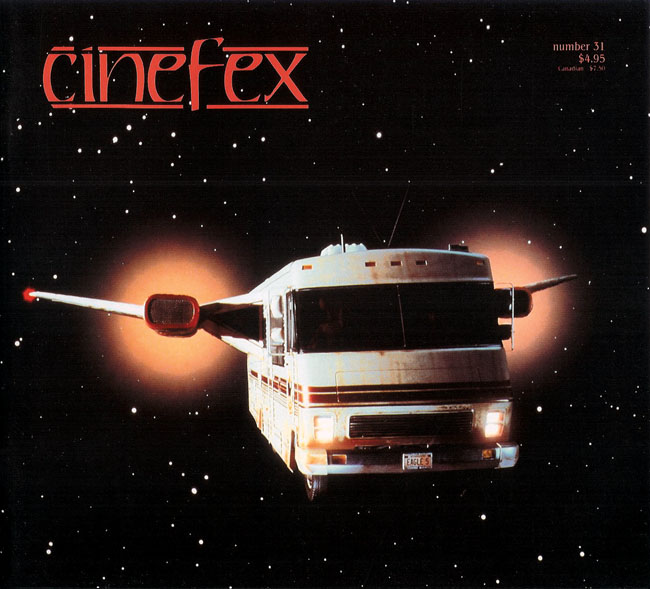
<FONT COLOR='#ff0000'>Spaceballs: Spaceballs - The Special Effects</FONT>: In focusing his singular sense of humor on the science fiction film genre, Mel Brooks realized the ease with which he could have milked a few extra laughs by employing deliberately poor special effects. But instead, he wanted his parody to work within the context of a high-gloss production. To this end, he enlisted visual effects supervisor Peter Donen. Working primarily with Apogee - but with outside input from Illusion Arts and Industrial Light & Magic - Donen was able to orchestrate a full and varied array of cinematic illusions. Article by Mark Elliot<BR>
<FONT COLOR='#ff0000'>The Witches of Eastwick: Witch Trials</FONT>: For director George Miller, The Witches of Eastwick was a formidable challenge - a supernatural comedy with a top-notch cast that required a deft touch to maintain its proper balance of humor and horror. Though effects would take a back seat in the production, it was necessary that they be brought to bear on such thorny problems as depicting a palatial mansion that did not exist, creating a tennis ball with a mind of its own and transforming actor Jack Nicholson into a fifty-foot demon. Engaged to accomplish these and other feats were Industrial Light & Magic and makeup effects artist Rob Bottin. Article by Adam Eisenberg<BR>
<FONT COLOR='#ff0000'>Masters of the Universe</FONT>: Though derived from a phenomenally popular toy line, Masters of the Universe would prove to be anything but fun and games for production designer William Stout, visual effects supervisor Richard Edlund and makeup artist Michael Westmore. With high expectations but minimal time and resources, the design and effects teams had to translate plastic dolls into flesh-and-blood characters, create a faraway fantasy world from scratch and implant nonstop optical trickery into a sword-and-sorcery adventure of extravagant proportions. Article by Ron Magid
<FONT COLOR='#ff0000'>The Witches of Eastwick: Witch Trials</FONT>: For director George Miller, The Witches of Eastwick was a formidable challenge - a supernatural comedy with a top-notch cast that required a deft touch to maintain its proper balance of humor and horror. Though effects would take a back seat in the production, it was necessary that they be brought to bear on such thorny problems as depicting a palatial mansion that did not exist, creating a tennis ball with a mind of its own and transforming actor Jack Nicholson into a fifty-foot demon. Engaged to accomplish these and other feats were Industrial Light & Magic and makeup effects artist Rob Bottin. Article by Adam Eisenberg<BR>
<FONT COLOR='#ff0000'>Masters of the Universe</FONT>: Though derived from a phenomenally popular toy line, Masters of the Universe would prove to be anything but fun and games for production designer William Stout, visual effects supervisor Richard Edlund and makeup artist Michael Westmore. With high expectations but minimal time and resources, the design and effects teams had to translate plastic dolls into flesh-and-blood characters, create a faraway fantasy world from scratch and implant nonstop optical trickery into a sword-and-sorcery adventure of extravagant proportions. Article by Ron Magid
Issue 32 1987
Main Cover
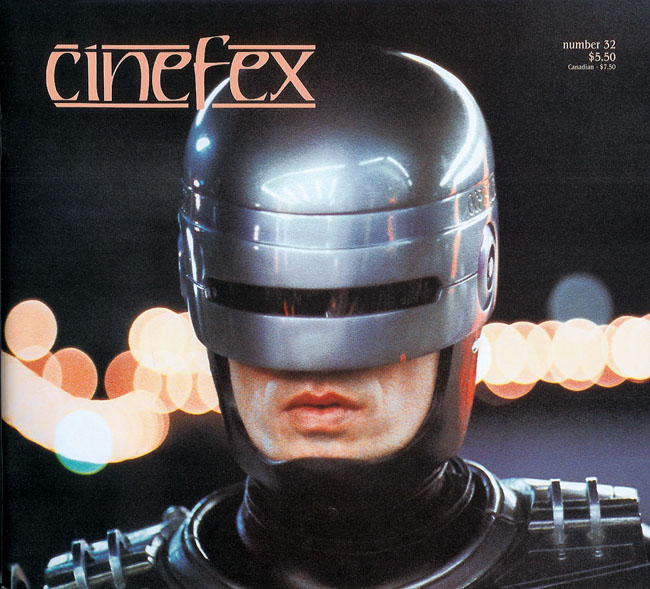
<FONT COLOR='#ff0000'>RoboCop: Shooting RoboCop</FONT>: Big city crime has turned Old Detroit into a combat zone. Decent citizens can no longer venture forth onto the streets, day or night, and even police officers are prime targets for murder and mayhem. Clearly something must be done. The answer as proposed in Jon Davison's production of RoboCopis a new breed of urban crime-fighter - half man, half machine, all business. Engaged to create this cyborg superhero were film director Paul Verhoeven, actor Peter Weller and makeup effects artist Rob Bottin. Also contributing to the futuristic ambience were ED 209 supervisor Peter Kuran, matte artist Rocco Gioffre and a host of others who discuss in detail their experiences on this most explosive of box office hits. Article by Paul M. Sammon<BR>
<FONT COLOR='#ff0000'>Innerspace: Inside Martin Short</FONT>: For most directors, getting inside one's characters is an intellectual exercise. But for Joe Dante, Innerspace represented a literal opportunity to explore on film the inner workings of a human being - specifically, supermarket clerk Jack Putter who, as a consequence of a miscarried microscopic submersible pod manned by test pilot Tuck Pendelton. Enlisted to design and produce the innespace footage was visual effects supervisor Dennis Muren of Industrial Light & Magic. Mixing anatomical realism with dramatic fancy, Muren and his associates produced both miniaturization effects and macroscopic excursions through the innermost recesses of actor Martin Short's eyes, ears, blood stream, stomach and lungs. Article by Janine Pourroy
<FONT COLOR='#ff0000'>Innerspace: Inside Martin Short</FONT>: For most directors, getting inside one's characters is an intellectual exercise. But for Joe Dante, Innerspace represented a literal opportunity to explore on film the inner workings of a human being - specifically, supermarket clerk Jack Putter who, as a consequence of a miscarried microscopic submersible pod manned by test pilot Tuck Pendelton. Enlisted to design and produce the innespace footage was visual effects supervisor Dennis Muren of Industrial Light & Magic. Mixing anatomical realism with dramatic fancy, Muren and his associates produced both miniaturization effects and macroscopic excursions through the innermost recesses of actor Martin Short's eyes, ears, blood stream, stomach and lungs. Article by Janine Pourroy