
2000
Issue 80
January/February/March

January/February/March
A Look Back : With this issue, Cinefex is marking its twentieth year, an occasion that has prompted us to take a wholly subjective look back -- to reflect on how Cinefex
came to be, how the effects industry has evolved since the magazine's inception,
and to recall some of the highlights of the last two decades.
20 Questions: We asked a few of our friends in the business to help us celebrate our 20th anniversary by offering up their considered opinions as to the best effects sequences
of the past 20 years. Also, in an unprecedented display of subjectivity, Cinefex
editorial staff members picked their own personal favorites.
Stuart Little: All Things Great and Little: Under director Rob Minkoff and senior effects supervisor John Dykstra, animators at Sony Pictures Imageworks created a photoreal, if fanciful, computer generated mouse for Stuart Little that effectively carried the movie, while artists at Rhythm & Hues
and Centropolis Effects supplied lip-sync to a supporting cast of talking cats.
article by Kevin H. Martin
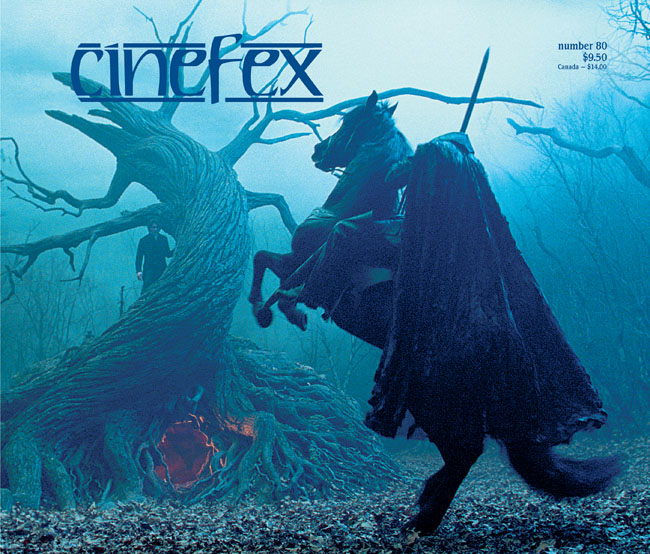
Sleepy Hollow: A Region of Shadows: For his horrific, yet stylish Sleepy Hollow, director Tim Burton created a post-colonial New York village in England and assigned effects teams at Industrial
Light & Magic, The Computer Film Company and Kevin Yagher Productions to supply
a murderous headless horseman and a gruesome array of decapitation victims.
article by Mark Cotta Vaz
Fight Club: A World of Hurt: In Fight Club, director David Fincher concocted subtle visual effects to get inside the twisted mind of his film's narrator. With oversight from visual effects supervisor
Kevin Tod Haug, teams at Digital Domain, Pixel Liberation Front, BUF, Image Savant,
Blue Sky, Command Post/Toybox and Gray Matter contributed to the effort.
article by Kevin H. Martin
Harryhausen & Tippett: The Motion in Our Minds: A one-on-one interview with stop-motion maestro Ray Harryhausen by Phil Tippett.
came to be, how the effects industry has evolved since the magazine's inception,
and to recall some of the highlights of the last two decades.
20 Questions: We asked a few of our friends in the business to help us celebrate our 20th anniversary by offering up their considered opinions as to the best effects sequences
of the past 20 years. Also, in an unprecedented display of subjectivity, Cinefex
editorial staff members picked their own personal favorites.
Stuart Little: All Things Great and Little: Under director Rob Minkoff and senior effects supervisor John Dykstra, animators at Sony Pictures Imageworks created a photoreal, if fanciful, computer generated mouse for Stuart Little that effectively carried the movie, while artists at Rhythm & Hues
and Centropolis Effects supplied lip-sync to a supporting cast of talking cats.
article by Kevin H. Martin
Sleepy Hollow: A Region of Shadows: For his horrific, yet stylish Sleepy Hollow, director Tim Burton created a post-colonial New York village in England and assigned effects teams at Industrial
Light & Magic, The Computer Film Company and Kevin Yagher Productions to supply
a murderous headless horseman and a gruesome array of decapitation victims.
article by Mark Cotta Vaz
Fight Club: A World of Hurt: In Fight Club, director David Fincher concocted subtle visual effects to get inside the twisted mind of his film's narrator. With oversight from visual effects supervisor
Kevin Tod Haug, teams at Digital Domain, Pixel Liberation Front, BUF, Image Savant,
Blue Sky, Command Post/Toybox and Gray Matter contributed to the effort.
article by Kevin H. Martin
Harryhausen & Tippett: The Motion in Our Minds: A one-on-one interview with stop-motion maestro Ray Harryhausen by Phil Tippett.
A Look Back : With this issue, Cinefex is marking its twentieth year, an occasion that has prompted us to take a wholly subjective look back -- to reflect on...
more

Issue 81
April/May/June

April/May/June

Mission to Mars: Mission Accomplished :
For Mission to Mars, a science fiction film from director Brian De Palma,
visual effects teams at Dream Quest Images, Industrial Light & Magic and Tippett
Studio used motion control miniatures and a wide range of digital effects to lend
dazzling verisimilitude to the cinematic depiction of NASA's first manned
mission to the red planet - and the staggering revelations that follow.
article by Kevin H. Martin
End of Days: Days of Fire and Brimstone:
Capitalizing on Y2K doomsday predictions, End of Days dramatizes the
biblically prophesied return of Satan to earth on the eve of the millennium. Working
with director Peter Hyams, visual effects supervisor Eric Durst oversaw the efforts
of several effects companies to manifest the devil in his true form and dramatize
his epic struggle with the one man determined to thwart him.
article by Kevin H. Martin
Galaxy Quest: Trekking into the Klaatu Nebula:
In an affectionate sendup of the Star Trek franchise and its devoted following,
Galaxy Quest tells the tale of a washed-up band of actors who give the performance
of their lives in a real-life space adventure. As lead effects house on the Dean
Parisot film, Industrial Light & Magic relied on miniature spaceships and
computer generated creatures to enliven the proceedings.
article by Jody Duncan & Estelle Shay
Bicentennial Man: In His Own Image.
Toy Story 2: Beyond Andy's Room.
Pitch Black: Chimera of the Night.
For Mission to Mars, a science fiction film from director Brian De Palma,
visual effects teams at Dream Quest Images, Industrial Light & Magic and Tippett
Studio used motion control miniatures and a wide range of digital effects to lend
dazzling verisimilitude to the cinematic depiction of NASA's first manned
mission to the red planet - and the staggering revelations that follow.
article by Kevin H. Martin
End of Days: Days of Fire and Brimstone:
Capitalizing on Y2K doomsday predictions, End of Days dramatizes the
biblically prophesied return of Satan to earth on the eve of the millennium. Working
with director Peter Hyams, visual effects supervisor Eric Durst oversaw the efforts
of several effects companies to manifest the devil in his true form and dramatize
his epic struggle with the one man determined to thwart him.
article by Kevin H. Martin
Galaxy Quest: Trekking into the Klaatu Nebula:
In an affectionate sendup of the Star Trek franchise and its devoted following,
Galaxy Quest tells the tale of a washed-up band of actors who give the performance
of their lives in a real-life space adventure. As lead effects house on the Dean
Parisot film, Industrial Light & Magic relied on miniature spaceships and
computer generated creatures to enliven the proceedings.
article by Jody Duncan & Estelle Shay
Bicentennial Man: In His Own Image.
Toy Story 2: Beyond Andy's Room.
Pitch Black: Chimera of the Night.
Mission to Mars: Mission Accomplished : For Mission to Mars, a science fiction film from director Brian De Palma, visual effects teams at Dream Quest Images, Industrial Light & Magic...
more

Issue 82
July/August/September

July/August/September
Dinosaur: Engendered Species: The feature animation division of Walt Disney Studios created an all-new digital
facility to support its first computer generated film, Dinosaur, about an orphaned
iguanodon whose gentle ways come in conflict with his species' baser instincts.
Contributing to the movie's novel look were deftly orchestrated visual effects
that blended CG characters with digitally processed live-action backgrounds.
The Perfect Storm: Perfecting the Storm: A real-life tragedy recounted in the book The Perfect Storm provided the basis
for director Wolfgang Petersen's movie of the same name, about a swordfishing boat
lost at sea during a storm of unprecedented ferocity. Raising the bar on CG water
effects, Industrial Light & Magic produced the digitally engineered tempest,
designed to work in concert with large-scale stage effects by John Frazier.
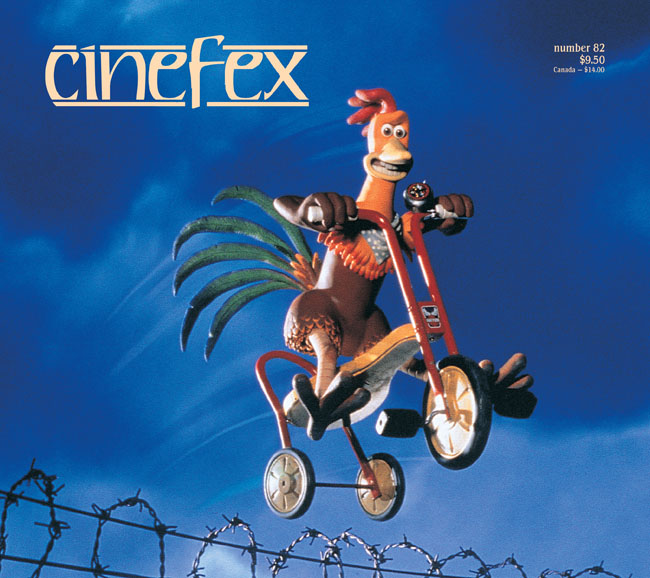
Chicken Run: Poultry in Motion: Aardman Animations, of Wallace and Gromit renown, graduated to feature status
with Chicken Run, a sendup of The Great Escape, in which a farm's resident chickens
hatch a desperate plan to escape being turned into pot pies. Though the comedy
employed Aardman's signature stop-motion puppeteering, it also benefited
from a range of digital contributions by Computer Film Company.
Gladiator: A Cut Above
U-571: Hostile Waters
Battlefield Earth: Battle Fatigue
facility to support its first computer generated film, Dinosaur, about an orphaned
iguanodon whose gentle ways come in conflict with his species' baser instincts.
Contributing to the movie's novel look were deftly orchestrated visual effects
that blended CG characters with digitally processed live-action backgrounds.
The Perfect Storm: Perfecting the Storm: A real-life tragedy recounted in the book The Perfect Storm provided the basis
for director Wolfgang Petersen's movie of the same name, about a swordfishing boat
lost at sea during a storm of unprecedented ferocity. Raising the bar on CG water
effects, Industrial Light & Magic produced the digitally engineered tempest,
designed to work in concert with large-scale stage effects by John Frazier.
Chicken Run: Poultry in Motion: Aardman Animations, of Wallace and Gromit renown, graduated to feature status
with Chicken Run, a sendup of The Great Escape, in which a farm's resident chickens
hatch a desperate plan to escape being turned into pot pies. Though the comedy
employed Aardman's signature stop-motion puppeteering, it also benefited
from a range of digital contributions by Computer Film Company.
Gladiator: A Cut Above
U-571: Hostile Waters
Battlefield Earth: Battle Fatigue
Dinosaur: Engendered Species: The feature animation division of Walt Disney Studios created an all-new digital facility to support its first computer generated film, Dinosaur, about an orphaned iguanodon whose gentle...
more

Issue 83
October/November/December

October/November/December

X-Men: The X-Men Cometh: Plagued by budget and time constraints, plus a burgeoning effects slate, visual effects supervisor Michael L. Fink overcame the odds on X-Men, a fantasy
based on the enduring Marvel comic books. To handle the film's array of mutant characters -- all exhibiting singular mental or physical powers that distinguish them from ordinary humans -- Fink divided the work among some nine visual effects companies, assigning each a particular character or type of effect. Other key contributors were physical effects coordinator Colin Chilvers and makeup effects supervisor Gordon Smith. Article by Kevin H. Martin
Hollow Man: Disappearing Act : To depict the invisible protagonist at the heart of Hollow Man, veteran director Paul Verhoeven engaged Sony Pictures Imageworks and senior visual effects
supervisor Scott Anderson to pull out all the stops, duplicating actor Kevin Bacon's physiology and live performance with a digital replica capable of revealing the character's anatomy from the inside out. Also assuming a
sizable share of the workload was Tippett Studio, under visual effects supervisor Craig Hayes. Rounding out the effort were practical effects by Stan Parks and makeup by Amalgamated Dynamics Incorporated.
Article by Estelle Shay
The Cell: Mindscape Architects
The Patriot: Picking His Battles
What Lies Beneath: Hitchcock Homage
based on the enduring Marvel comic books. To handle the film's array of mutant characters -- all exhibiting singular mental or physical powers that distinguish them from ordinary humans -- Fink divided the work among some nine visual effects companies, assigning each a particular character or type of effect. Other key contributors were physical effects coordinator Colin Chilvers and makeup effects supervisor Gordon Smith. Article by Kevin H. Martin
Hollow Man: Disappearing Act : To depict the invisible protagonist at the heart of Hollow Man, veteran director Paul Verhoeven engaged Sony Pictures Imageworks and senior visual effects
supervisor Scott Anderson to pull out all the stops, duplicating actor Kevin Bacon's physiology and live performance with a digital replica capable of revealing the character's anatomy from the inside out. Also assuming a
sizable share of the workload was Tippett Studio, under visual effects supervisor Craig Hayes. Rounding out the effort were practical effects by Stan Parks and makeup by Amalgamated Dynamics Incorporated.
Article by Estelle Shay
The Cell: Mindscape Architects
The Patriot: Picking His Battles
What Lies Beneath: Hitchcock Homage
X-Men: The X-Men Cometh: Plagued by budget and time constraints, plus a burgeoning effects slate, visual effects supervisor Michael L. Fink overcame the odds on X-Men, a fantasy based on...
more
