

1980
Issue 1

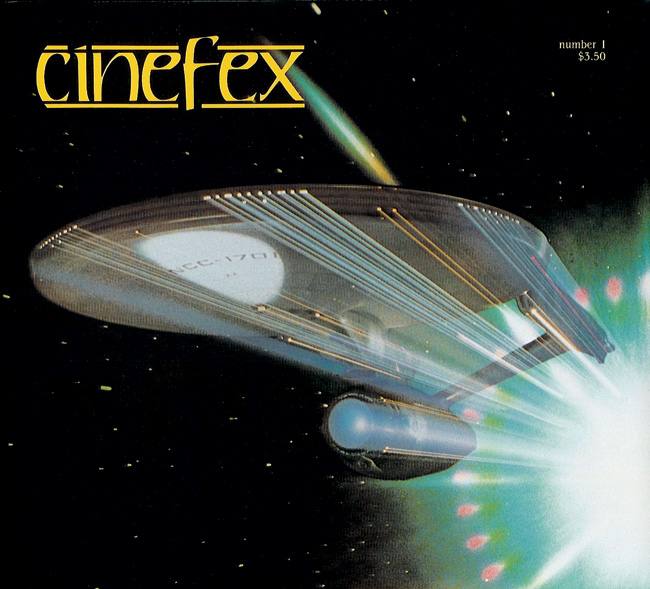
Star Trek - The Motion Picture: Into the V'ger Maw with Douglas Trumbull: With only nine months remaining before its world premiere, Douglas Trumbull stepped in as director of special effects for Star Trek - The Motion Picture. Five hundred effects shots later, the multimillion dollar space epic was completed - on schedule. Trumbull discusses with candor the organizational and technical shortcomings which led to the dismissal of the original effects unit, and his own subsequent efforts to salvage the beleaguered production. In addition to his personal redesign of the effects sequences, Trumbull details the extensive research and development effort, the crushing workload, and the specific techniques employed in achieving many of Star Trek's most spectacular moments. Interview by Don Shay
Alien: Creating an Alien Ambience: As had no other film before, Alien was utterly successful in attaining a convincing depiction of alien lifeforms, artifacts and environs. Conceived first in the mind of screenwriter Dan O'Bannon, and then translated into visual terms by surrealist painter H.R. Giger, Alien was not only a consummate shocker, but also a work of great aesthetic virtuosity. Particularly demanding was the alien polymorph - from its earliest forms constructed by Roger Dicken to the full-size monstrosity sculpted by H.R.Giger and activated by Carlo Rambaldi. Equally of note were the complex otherworld sets built under the supervision of production designer Michael Seymour, and the extensive special effects engineered by Brian Johnson and Nick Allder. These and other craftsmen discuss in detail the collaborative effort behind Alien's pervasive atmosphere of eerie realism. Article by Don Shay
Alien: Creating an Alien Ambience: As had no other film before, Alien was utterly successful in attaining a convincing depiction of alien lifeforms, artifacts and environs. Conceived first in the mind of screenwriter Dan O'Bannon, and then translated into visual terms by surrealist painter H.R. Giger, Alien was not only a consummate shocker, but also a work of great aesthetic virtuosity. Particularly demanding was the alien polymorph - from its earliest forms constructed by Roger Dicken to the full-size monstrosity sculpted by H.R.Giger and activated by Carlo Rambaldi. Equally of note were the complex otherworld sets built under the supervision of production designer Michael Seymour, and the extensive special effects engineered by Brian Johnson and Nick Allder. These and other craftsmen discuss in detail the collaborative effort behind Alien's pervasive atmosphere of eerie realism. Article by Don Shay
Star Trek - The Motion Picture: Into the V'ger Maw with Douglas Trumbull: With only nine months remaining before its world premiere, Douglas Trumbull stepped in as director of special...
more

Issue 2

On cover:
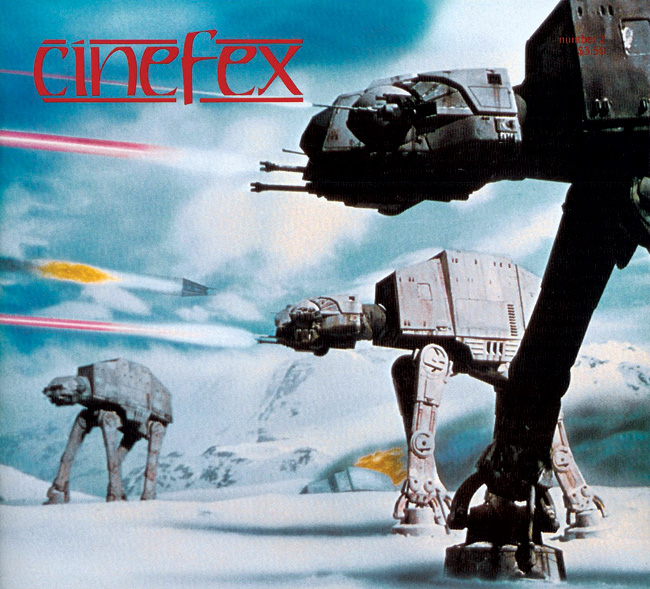
The Empire Strikes Back: Of Ice Planets, Bog Planets and Cities in the Sky: As special effects supervisor for The Empire Strikes Back, Richard Edlund was responsible for reestablishing the Star Wars effects facility and presiding over the production of some four hundred optical effects shots. A seasoned veteran of the original Lucasfilm epic, Edlund discusses how three years of advancing technology, coupled with a top notch technical crew enabled Industrial Light & Magic to segue into an even more complex project - and with better results ... Article by Don Shay
Greg Jein - Miniature Giant: From less than auspicious beginnings sculpting spacecraft models for porno parodies and student films, two-time Oscar nominee Greg Jein has become - in five years - one of the giants in the field of movie miniatures. In addition to detailing his early work, accounts are provided of his landscapes and mothership for Close Encounters of the Third Kind, the remarkable detailed settings of 1941, the V'ger interior and spacewalks props for Star Trek - The Motion Picture, and the add-on work for Close Encounters reissue. Article by Brad Munson
Star Trek - The Motion Picture: Star Trekking at Apogee with John Dykstra: Approximately one third of the optical work in Star Trek - The Motion Picture was produced under the supervision of John Dykstra at his Apogee effects facility. Covering Apogee's involvement from stem to stern, Dykstra discusses in detail the Klingon and Epsilon 9 sequences and the exterior V'ger passage. He further elaborates on Apogee's approach to the digitization and energy probe effects, as well as some old standards such as the transporter beams and photon torpedos. Article by Don Shay
Greg Jein - Miniature Giant: From less than auspicious beginnings sculpting spacecraft models for porno parodies and student films, two-time Oscar nominee Greg Jein has become - in five years - one of the giants in the field of movie miniatures. In addition to detailing his early work, accounts are provided of his landscapes and mothership for Close Encounters of the Third Kind, the remarkable detailed settings of 1941, the V'ger interior and spacewalks props for Star Trek - The Motion Picture, and the add-on work for Close Encounters reissue. Article by Brad Munson
Star Trek - The Motion Picture: Star Trekking at Apogee with John Dykstra: Approximately one third of the optical work in Star Trek - The Motion Picture was produced under the supervision of John Dykstra at his Apogee effects facility. Covering Apogee's involvement from stem to stern, Dykstra discusses in detail the Klingon and Epsilon 9 sequences and the exterior V'ger passage. He further elaborates on Apogee's approach to the digitization and energy probe effects, as well as some old standards such as the transporter beams and photon torpedos. Article by Don Shay
The Empire Strikes Back: Of Ice Planets, Bog Planets and Cities in the Sky: As special effects supervisor for The Empire Strikes Back, Richard Edlund was responsible for reestablishing the...
more

On cover:
Issue 3

On cover:
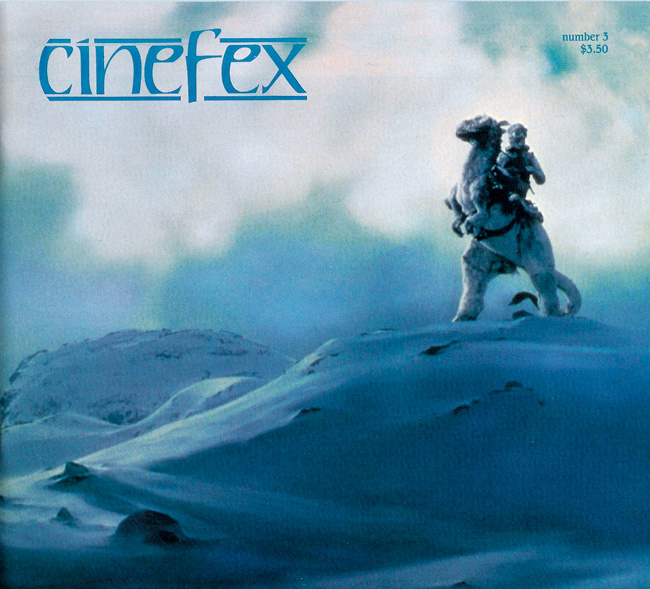
The Empire Strikes Back: Tauntauns, Walkers and Probots: Employing a variety of techniques, ranging from vintage Willis O'brien-type steps to modern motion control technology, the special effects wizards at Industrial Light & Magic produced a dazzling array of stop motion wonders for The Empire Strikes Back. Effects director of photography Dennis Muren, stop motion animator Phil Tippett, art director Joe Johnston and other key members of the ILM effects unit discuss the complex animation sequences from start to finish. Article by Paul Mandell
Walter Murch - Making Beaches Out of Grains of Sand: Some of the most significant recent developments in motion pictures involve not what is seen, but rather what is heard. Academy Awardwinner Walter Murch, the virtuoso whose work figures prominently in some of the pivotal films of our time, discusses the subtle, psychological, mostly invisible art of sound - from the recording of a single isolated audio track to the monumental mixing of a hundred or more at once. Article by Jordan Fox
The Microcosmic World of Ken Middleham: Phase IV was anything but a typical science fiction film. No spaceships, no alien invaders, no unleashed technological horrors - just ants. But not ordinary ants. Ants with geometric patterns emblazoned on their foreheads; ants unafraid to engage a praying mantis in battle; ants that bestow ceremonial honors on their fallen dead; and ants that transport crystals of posionous material in a suicidal death march. Ace macro cinematographer Ken Middleham discusses the creation and photography of these uncharacteristic ant behaviors. Article by Don Shay
Walter Murch - Making Beaches Out of Grains of Sand: Some of the most significant recent developments in motion pictures involve not what is seen, but rather what is heard. Academy Awardwinner Walter Murch, the virtuoso whose work figures prominently in some of the pivotal films of our time, discusses the subtle, psychological, mostly invisible art of sound - from the recording of a single isolated audio track to the monumental mixing of a hundred or more at once. Article by Jordan Fox
The Microcosmic World of Ken Middleham: Phase IV was anything but a typical science fiction film. No spaceships, no alien invaders, no unleashed technological horrors - just ants. But not ordinary ants. Ants with geometric patterns emblazoned on their foreheads; ants unafraid to engage a praying mantis in battle; ants that bestow ceremonial honors on their fallen dead; and ants that transport crystals of posionous material in a suicidal death march. Ace macro cinematographer Ken Middleham discusses the creation and photography of these uncharacteristic ant behaviors. Article by Don Shay
The Empire Strikes Back: Tauntauns, Walkers and Probots: Employing a variety of techniques, ranging from vintage Willis O'brien-type steps to modern motion control technology, the special effects wizards at Industrial...
more

On cover:
Issue 4

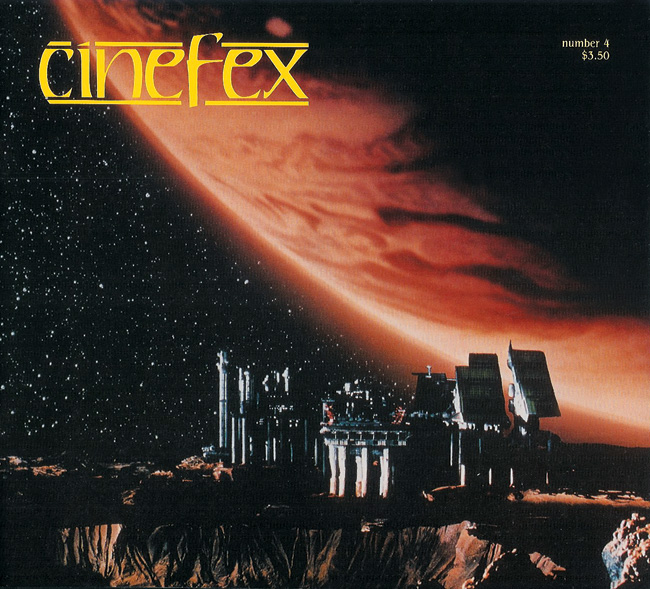
Outland: Outland is the first motion picture produced by the Ladd Company, whose management - formerly of 20th Century-Fox - inaugurated the current science fiction boom by giving George Lucas a chance to launch his Star Wars saga. It also marks the first major employment of Introvision - a new real-time matting system by which actors can be placed into front-projected plates. Writer-director Peter Hyams discusses his concept for the film and details some of the challenges involved in bringing the project to fruition. Providing added commentary are ditector of photography Stephen Goldblatt, special effects supervisor John Stears, modelmaker Bill Pearson, plate photographer Douglas Dawson, and Introvision team members John Eppolito, Tom Naud, William Mesa and Tim Donahue. Article by Don Shay
The Altered States of 'Altered States': After barely surviving the trauma of going through two major film studios, two directors, two production designers, and two special effects units - not to mention an array of ever-changing concepts and a writer who disowned the project - Altered States emerged from near-oblivion in remarkably healthy condition. Production designer Joe Alves and special effects supervisor John Dykstra discuss their involvement in the aborted Arthur Penn production. Then, visual effects coordinator Bran Ferren, director of photography Jordan Cronenweth, production designer Richard McDonald, and optical effects expert Robbie Blalack elaborate upon the regenerated Ken Russell version. Tying the narrative together is special makeup artist Dick Smith, and his assistant Carl Fullerton, who rode out the production maelstrom from beginning to end. Article by Paul Mandell
The Altered States of 'Altered States': After barely surviving the trauma of going through two major film studios, two directors, two production designers, and two special effects units - not to mention an array of ever-changing concepts and a writer who disowned the project - Altered States emerged from near-oblivion in remarkably healthy condition. Production designer Joe Alves and special effects supervisor John Dykstra discuss their involvement in the aborted Arthur Penn production. Then, visual effects coordinator Bran Ferren, director of photography Jordan Cronenweth, production designer Richard McDonald, and optical effects expert Robbie Blalack elaborate upon the regenerated Ken Russell version. Tying the narrative together is special makeup artist Dick Smith, and his assistant Carl Fullerton, who rode out the production maelstrom from beginning to end. Article by Paul Mandell
Outland: Outland is the first motion picture produced by the Ladd Company, whose management - formerly of 20th Century-Fox - inaugurated the current science fiction boom by giving George Lucas...
more

1981
Issue 5

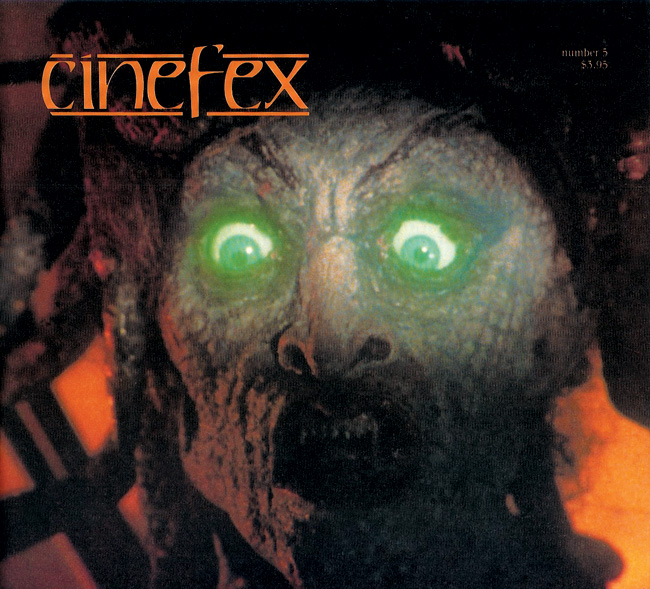
Ray Harryhausen - Acting Without the Lumps: Ray Harryhausen is probably the only special effects artisan readily identified as the prime creative force behind the films with which he is associated. The enigmatic grandmaster of animation discusses with candor his formative years, his feelings about fantasy and filmmaking, and the highs and lows of a singular career which has spanned more than three decades. Article by Vic Cox
Clash of the (Foot-Tall) Titans: For his sixteenth feature film, Ray Harryhausen has returned once again to the world of classical mythology. For the first time, however, he did so in the company of two associate animators. Jim Danforth and Steven Archer. Together, the three discuss the origins of the projects and the many months of postproduction involved in bringing Harryhausen's most ambitous film undertaking to the screen. Article by Don Shay
Roy Arbogast: When grandiose special effects are required 'live' during main unit photography, the job is likely to fall to effects expert Roy Arbogast. Arbogast, a veteran of both Jaws films, Close Encounters of the Third Kind, Dracula and The Incredible Shrinking Woman, discusses the field of mechanical effects and his varied work in a wide range of contemporary features. Ariticle by Jordan Fox
Caveman - The Real Stars: Writer-director Carl Gottlieb's irreverent sendup of the prehistoric melodrama provided fertile ground for some decidely unique stop-motion work. Effects supervisors Jim Danforth and Dave Allen, animators Randall William Cook and Pete Kleinow, and optical technician Spencer Gill discuss the tempestuous production. Article by Scott Vanderbilt
Clash of the (Foot-Tall) Titans: For his sixteenth feature film, Ray Harryhausen has returned once again to the world of classical mythology. For the first time, however, he did so in the company of two associate animators. Jim Danforth and Steven Archer. Together, the three discuss the origins of the projects and the many months of postproduction involved in bringing Harryhausen's most ambitous film undertaking to the screen. Article by Don Shay
Roy Arbogast: When grandiose special effects are required 'live' during main unit photography, the job is likely to fall to effects expert Roy Arbogast. Arbogast, a veteran of both Jaws films, Close Encounters of the Third Kind, Dracula and The Incredible Shrinking Woman, discusses the field of mechanical effects and his varied work in a wide range of contemporary features. Ariticle by Jordan Fox
Caveman - The Real Stars: Writer-director Carl Gottlieb's irreverent sendup of the prehistoric melodrama provided fertile ground for some decidely unique stop-motion work. Effects supervisors Jim Danforth and Dave Allen, animators Randall William Cook and Pete Kleinow, and optical technician Spencer Gill discuss the tempestuous production. Article by Scott Vanderbilt
Ray Harryhausen - Acting Without the Lumps: Ray Harryhausen is probably the only special effects artisan readily identified as the prime creative force behind the films with which he is...
more

Issue 6

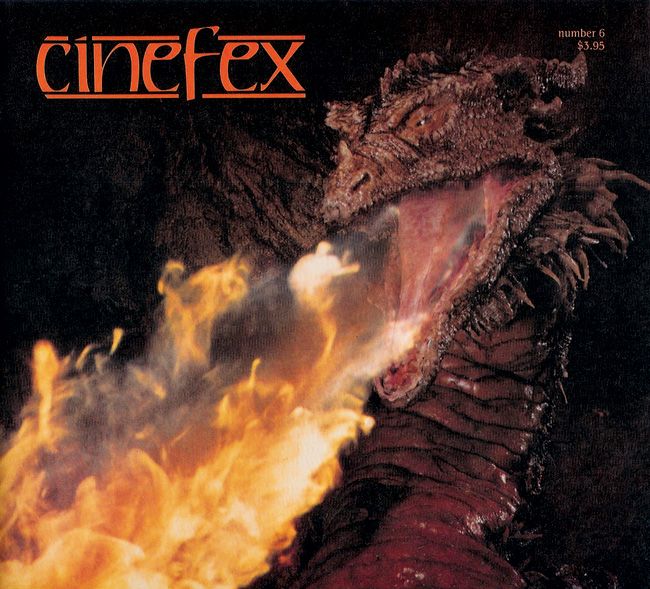
Computer Imaging - An Apple for the Dreamsmiths: It is unlikely that any technological breakthrough of the last decade will have as significant a long term impact on the way motion pictures look and are made than will the burgeoning field of computer generated imagery. From the earliest advances in the art and technique of computer animation to the current state of the art, a solid overview is presented on the past, present, and future of computer graphics, digital scene simulation and electronic compositing. Article by Peter Sorensen
Dragonslayer: When Hal Barwood and Matthew Robbins set out to make a sword and sorcery fantasy, they had no idea it would spawn the most significant innovation in dimensional animation since its inception. Industrial Light & Magic dragon masters Dennis Muren, Phil Tippett and Ken Ralston discuss the development and utilization of 'go-motion' animation, aided and abetted by dragon mover engineer Stuart Ziff, optical supervisor Bruce Nicholson, armature builder Tom St. Amand, miniature set builder Dave Carson, matte painting supervisor Alan Maley, makeup artist Chris Walas, and animation supervisor Sam Comstock. Non-ILM involvement is recounted by dragon designer David Bunnett, full sized prop maker Danny Lee, and VCE animation supervisor Peter Kuran. Article by S.S. Wilson
Raiders of the Lost Ark: The Wrath of God . . . and Other Illusions: One of the more effective recent uses of special effects to enhance rather than dominate a film was in the Lucas-Spielberg production of Raiders of the Lost Ark. Discussing the climactic holocaust sequence and other optical work in the film are Industrial Light & Magic effects supervisor Richard Edlund, effects art director Joe Johnston, animation supervisor Sam Comstock, optical supervisor Bruce Nicholson, special effects makeup artist Chris Walas, cloud manufacturer Gary Platek, matte painting supervisor Alan Maley, and matte cameraman Neil Krepela. Article by Don Shay
Dragonslayer: When Hal Barwood and Matthew Robbins set out to make a sword and sorcery fantasy, they had no idea it would spawn the most significant innovation in dimensional animation since its inception. Industrial Light & Magic dragon masters Dennis Muren, Phil Tippett and Ken Ralston discuss the development and utilization of 'go-motion' animation, aided and abetted by dragon mover engineer Stuart Ziff, optical supervisor Bruce Nicholson, armature builder Tom St. Amand, miniature set builder Dave Carson, matte painting supervisor Alan Maley, makeup artist Chris Walas, and animation supervisor Sam Comstock. Non-ILM involvement is recounted by dragon designer David Bunnett, full sized prop maker Danny Lee, and VCE animation supervisor Peter Kuran. Article by S.S. Wilson
Raiders of the Lost Ark: The Wrath of God . . . and Other Illusions: One of the more effective recent uses of special effects to enhance rather than dominate a film was in the Lucas-Spielberg production of Raiders of the Lost Ark. Discussing the climactic holocaust sequence and other optical work in the film are Industrial Light & Magic effects supervisor Richard Edlund, effects art director Joe Johnston, animation supervisor Sam Comstock, optical supervisor Bruce Nicholson, special effects makeup artist Chris Walas, cloud manufacturer Gary Platek, matte painting supervisor Alan Maley, and matte cameraman Neil Krepela. Article by Don Shay
Computer Imaging - An Apple for the Dreamsmiths: It is unlikely that any technological breakthrough of the last decade will have as significant a long term impact on the way...
more

Issue 7

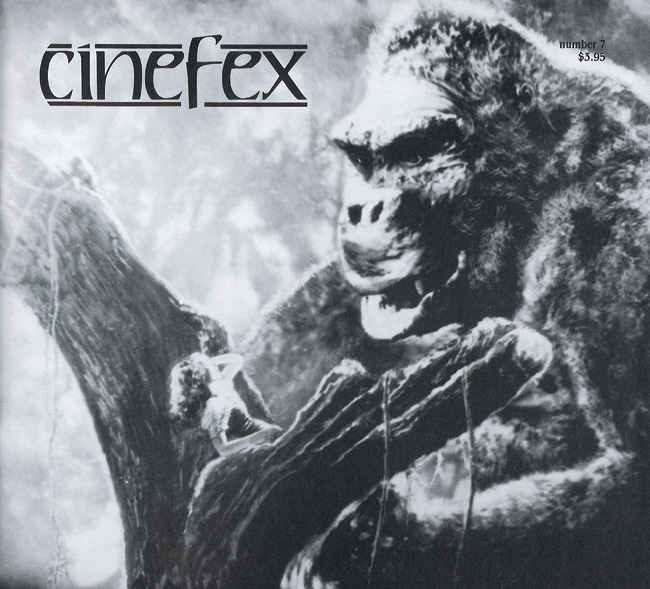
Willis O'Brien - Creator of the Impossible: It was mere chance that first led Willis O'Brien to consider the possibilities of producing cartoon-style animation with three-dimensional puppet figures. And while nearly seven decades have passed since his earliest attempts to imbue inanimate objects with a life of their own, the special effects form he introduced into the vocabulary of film has endured through the years relatively unscathed by the ravages of time. The Lost World, King Kong and Mighty Joe Young were all high water marks in the area of effects-oriented entertainment, and Willis O'Brien was at the heart of each. Though too many of his most ambitious projects - War Eagles, Gwangi, Valley of the Mist - were never to be realized at all, even his decidedly lesser efforts conveyed a sense of style and charm that was characteristically his own. But in counterpoint to his many triumphs, there is a darker side to the life and times of Willis O'Brien that carries with it an implied indictment of a user industry that fails to adequately recognize the strengths - and perhaps more importantly, the weaknesses - of some of its most gifted artists. On this, the eve of the twentieth anniversary of his death, Willis O'Brien's singular career is reexamined in detail, for he left behind him not only one of the great film classics of all time, but also a rich legacy of cinematic wonders and lasting inspiration. Article by Don Shay
Willis O'Brien - Creator of the Impossible: It was mere chance that first led Willis O'Brien to consider the possibilities of producing cartoon-style animation with three-dimensional puppet figures. And while...
more

Issue 8


Tronic Imagery: Tron signals the emergence of the Walt Disney organization from the black hole of formula filmmaking which has characterized the studio since the death of its founder. Combining state-of-the-art computer generated imagery with dazzling animation-enhanced live-action, the film creates an energy-charged parallel world of video games and electronic beings. Writer-director Steven Lisberger explains his concept for the film and traces the steps involved in seeing it through to fruition, while effects co-supervisors Richard Taylor and Harrison Ellenshaw reveal the technical aspects of the filic innovations employed. Providing additional details are conceptual artist Syd Mead, technical effects supervisor John Scheele, animation effects chief Lee Dyer, and nearly a dozen other technicians and artists. Article by Peter Sorensen
Silent Running: A rare journey into the humanistic side of science fiction, Silent Running was pieced together a decade ago by Douglas Trumbull and a team of dedicated technicians and designers, many of whom have since risen to prominence in the field of special effects. Trumbull details the evolution of the project and his involvement as writer-director and effects supervisor. Effects co-supervisors John Dykstra and Richard Yuricich explain the varied techniques involved in filming the space freighter Valley Forge. In addition, the transformation of a Navy aircraft carrier into a spaceship interior, the design and construction of the unique drone robots and mini-cars, and a variety of other production details are discussed at length by art director Wayne Smith, drone coordinators James Dow and Don Trumbull, and special designers Bill Short and Richard Alexander. Article by Pamela Duncan
Silent Running: A rare journey into the humanistic side of science fiction, Silent Running was pieced together a decade ago by Douglas Trumbull and a team of dedicated technicians and designers, many of whom have since risen to prominence in the field of special effects. Trumbull details the evolution of the project and his involvement as writer-director and effects supervisor. Effects co-supervisors John Dykstra and Richard Yuricich explain the varied techniques involved in filming the space freighter Valley Forge. In addition, the transformation of a Navy aircraft carrier into a spaceship interior, the design and construction of the unique drone robots and mini-cars, and a variety of other production details are discussed at length by art director Wayne Smith, drone coordinators James Dow and Don Trumbull, and special designers Bill Short and Richard Alexander. Article by Pamela Duncan
Tronic Imagery: Tron signals the emergence of the Walt Disney organization from the black hole of formula filmmaking which has characterized the studio since the death of its founder. Combining...
more

1982
Issue 9

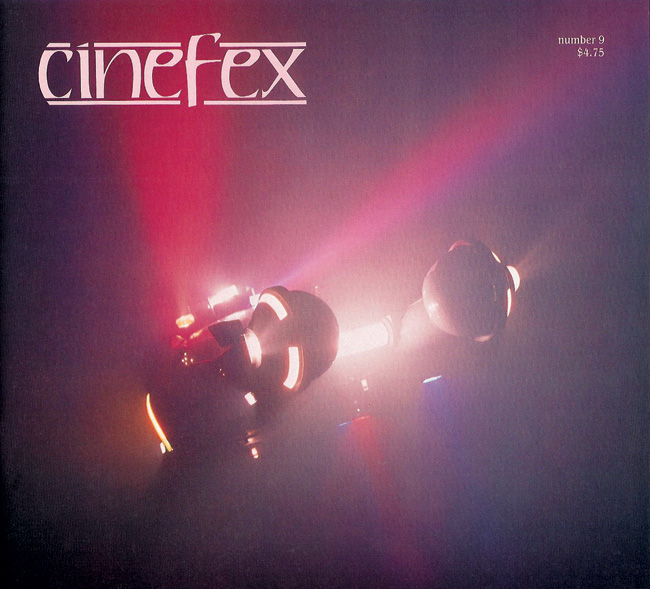
Blade Runner: 2020 Foresight: After more than a year of intensive labor, the visual effects craftsmen at Entertainment Effects Group have produced the definitive urban future for Blade Runner - Ridley Scott's stylish homage to film noir. A polluted overpopulated megalopolis, the Blade Runner city was created largely with miniatures and matte paintings - and effectssupervisors Douglas Trumbull, Richard Yuricich and David Dryer detail the arduous process by which it was generated and captured on film. On a broader scale, director Ridley Scott and design consultant Syd Meaddiscuss the evolution of the project and the philosophy behind its distinctive ambience. Adding further dimension are director of miniature photography Dave Stewart and cameraman Don Baker, matte painters Matthew Yuricichand Rocco Gioffre, designer Tom Cranham, model shop supervisorsMark Stetson and Wayne Smith and modelmaker Bill George, animation supervisor John Wash and cameraman Glenn Campbell. Compsy tech director Richard Hollander, optical supervisor Robert Hall, matte cameraman Robert Baily, still photographer Virgil Mirano, lab liaison Jack Hinkle and effects auditor Diana Gold. Together, they present one of the most thorough accounts ever of a major special effects project - covering the design, construction and photography of the massive Tyrell pyramids, the vast Hades wasteland, the extended cityscapes and the wondrous flying vehicles. Article by Don Shay
Blade Runner: 2020 Foresight: After more than a year of intensive labor, the visual effects craftsmen at Entertainment Effects Group have produced the definitive urban future for Blade Runner -...
more

Issue 10
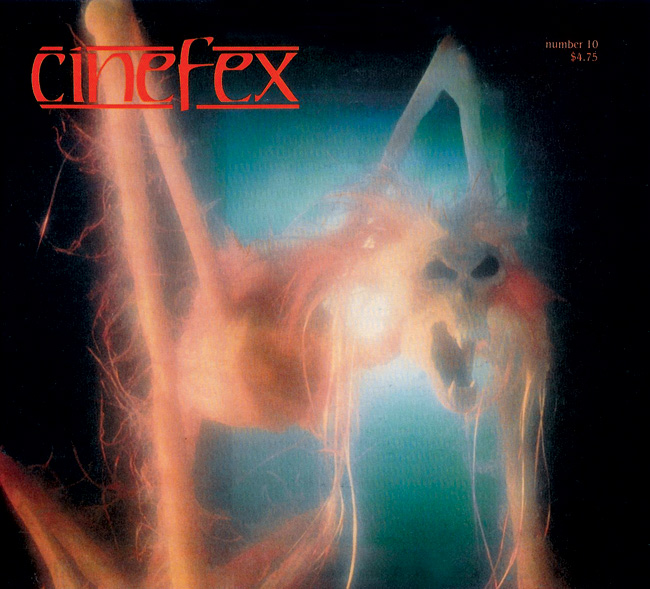
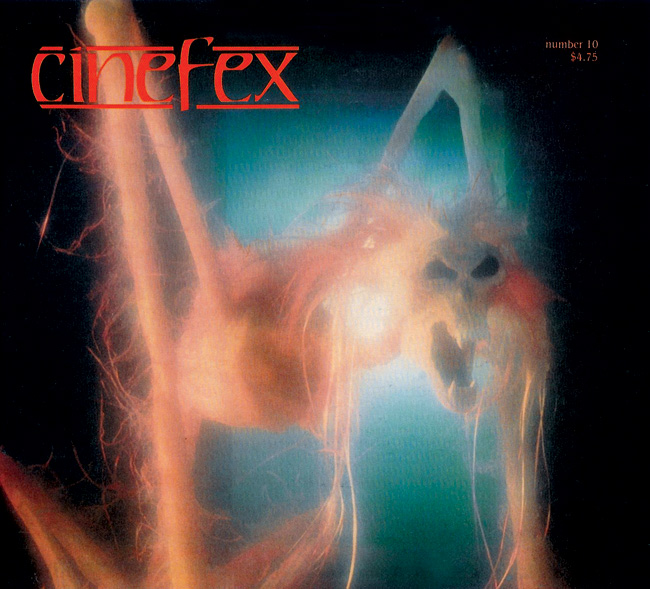
Poltergeist - Stilling the Restless Animus: When producer Steven Spielberg decided to raise hell in suburbia, he presented the cinemagicians of Industrial Light & Magic with their most formidable assignment to date. Poltergeist visual effects supervisor Richard Edlund, along with a dozen key members of his ILM effects unit, discusses the arduous creation of ghosts and goblins, passageways into other dimensions, imploding houses and numerous other paranormal phenomena. In addition, mechanical effects supervisor Michael Wood explains the complexities involved in bringing menacing trees to life and in trying to defy gravity, while Craig Reardon discusses the film's queasy makeup effects. Article by Paul Mandell
Mach 5 Effects - The Apogee of Firefox: Extraordinary challenges foster extraordinary ingenuity and innovation. Such was the case when superstar producer-director Clint Eastwood approached Apogee, Inc. with his Firefox project. As scripted, the film included a pivotal effects sequence featuring a fictitious pair of shiny metallic warplanes engaged in aerial combat against an optically foreboding environment of bright skies and sunlit clouds. Apogee rose to the challenge by completely rethinking the basic tenets of traditional traveling matte work and devising an altogether new process, along with a number of auxillary technologies and techniques designed to suspend audience disbelief. Effects producer John Dykstra, and seven key members of the Apogee team discuss the highs and lows of the landmark production. Article by Paul M. Sammon
Mach 5 Effects - The Apogee of Firefox: Extraordinary challenges foster extraordinary ingenuity and innovation. Such was the case when superstar producer-director Clint Eastwood approached Apogee, Inc. with his Firefox project. As scripted, the film included a pivotal effects sequence featuring a fictitious pair of shiny metallic warplanes engaged in aerial combat against an optically foreboding environment of bright skies and sunlit clouds. Apogee rose to the challenge by completely rethinking the basic tenets of traditional traveling matte work and devising an altogether new process, along with a number of auxillary technologies and techniques designed to suspend audience disbelief. Effects producer John Dykstra, and seven key members of the Apogee team discuss the highs and lows of the landmark production. Article by Paul M. Sammon
Poltergeist - Stilling the Restless Animus: When producer Steven Spielberg decided to raise hell in suburbia, he presented the cinemagicians of Industrial Light & Magic with their most formidable assignment...
more

Issue 11
On cover:
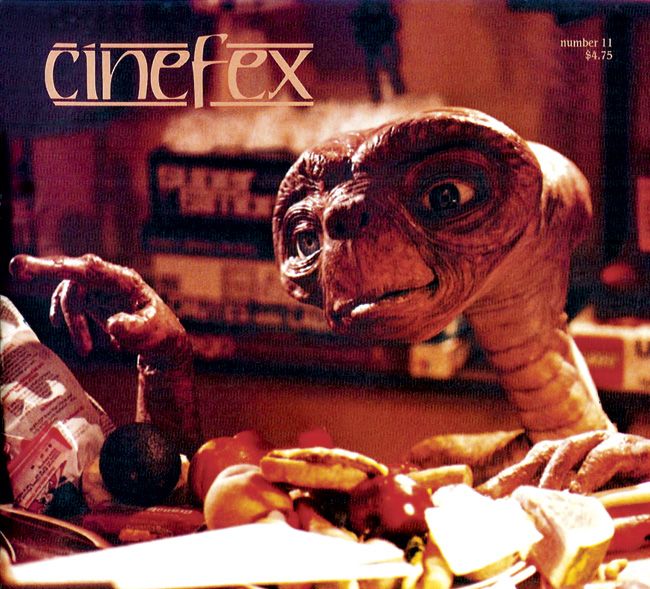
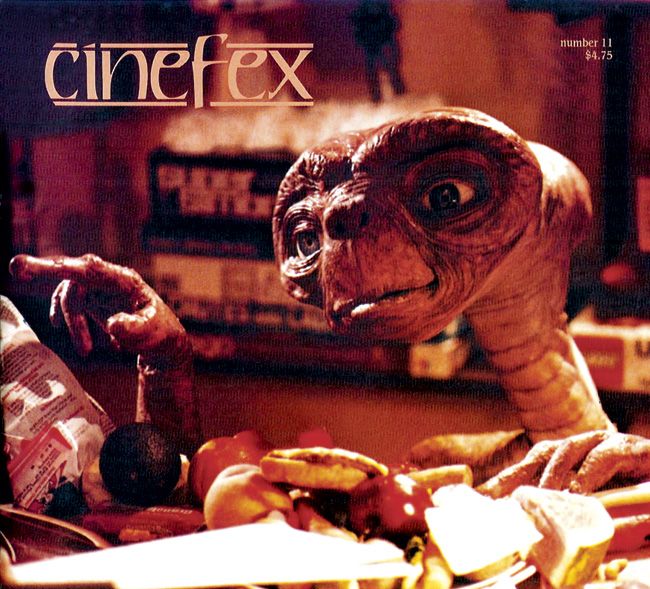
Turn on Your Heartlight - Inside E.T.: With $300 million in the till at year's end, E.T. is well on its way to becoming the most popular and profitable motion picture of all time. Superstar director Steven Spielberg and production supervisor Frank Marshall provide a comprehensive overview of E.T. - both the film and the phenomenon. Construction and activation of the celebrated extraterrestrial is discussed by Carlo Rambaldi, enhanced by contributions from Mitch Suskin, Robert Short, Caprice Rothe and Craig Reardon. Then, Industrial Light & Magic effects supervisor Dennis Muren - aided by fourteen members of his crew - reveals thesecrets behind E.T.'s flying bicycles, spaceships and other magical elements. Article by Paul M. Sammon
Special Visual Effects - Robert Swarthe: His contributions to the Close Encounters ensemble ranged from the flamboyant luminosity of the mothership underbelly to the subtle insertion of countless starlit skies. For Star Trek - The Motion Picture, he designed and supervised the vertiginous undulating wormhole interiors and the dazzling transcendence at the end. In the Close Encounters - Special Edition, he took us at last inside the awesome and wondrous alien mothership. Two-time Oscar nominee Robert Swarthe traces his way through these landmark effects productions, delves into his earlier animation work, and discusses his most recent efforts on behalf of One From the Heart and The Outsiders. Article by Don Shay
Special Visual Effects - Robert Swarthe: His contributions to the Close Encounters ensemble ranged from the flamboyant luminosity of the mothership underbelly to the subtle insertion of countless starlit skies. For Star Trek - The Motion Picture, he designed and supervised the vertiginous undulating wormhole interiors and the dazzling transcendence at the end. In the Close Encounters - Special Edition, he took us at last inside the awesome and wondrous alien mothership. Two-time Oscar nominee Robert Swarthe traces his way through these landmark effects productions, delves into his earlier animation work, and discusses his most recent efforts on behalf of One From the Heart and The Outsiders. Article by Don Shay
Turn on Your Heartlight - Inside E.T.: With $300 million in the till at year's end, E.T. is well on its way to becoming the most popular and profitable motion...
more

On cover:
Issue 12


Something Wicked This Way Comes - Adding the Magic: Culminating a gestation period which spanned nearly a quarter of a century, Ray Bradbury's chilling fantasy novel, Something Wicked This Way Comes, has at last materialized on the screen under the Disney banner. Ray Bradbury and director Jack Clayton discuss the origin and evolution of the project, while effects supervisor Lee Dyer - assisted by seven key department heads - details the elaborate mechanical and optical effects, makeup, miniatures, matte paintings and computer animation that transformed the film in postproduction. Article by Brad Munson
Stop-Frame Fever, Post-Animation Blues: After a short-lived resurgence in Clash of the Titans and Caveman, the venerable old art of stop-motion animation has slipped once again intothe role of supporting performer, struggling for a foothold among the superstar effects technologies of the day. Animators David Allen, Randall William Cook and Steven Archer discuss their respective efforts - successful and otherwise - at adding stop-motion moments to such recent and forthcoming productions as The Howling, Q, The Thing, The Hunger and Krull. Article by Paul Mandell
A Dream in the Making: From humble beginnings in a residential garage, Dream Quest has grown - in three short years - into one of the most highly respected effects facilities in the business. A close partnership comprised of six predominantly young, but seasoned professionals, the Dream Quest principals - Scott Squires, Rocco Gioffre, Hoyt Yeatman, Robert Hollister, Tom Hollister and Frederick Iguchi - recount their evolution as a company, their ancillary work on such projects as Escape from New York, E.T. and One From the Heart, their first solo outing on Blue Thunder, and their prospects for the future. Article by Marc A. Richardson
Stop-Frame Fever, Post-Animation Blues: After a short-lived resurgence in Clash of the Titans and Caveman, the venerable old art of stop-motion animation has slipped once again intothe role of supporting performer, struggling for a foothold among the superstar effects technologies of the day. Animators David Allen, Randall William Cook and Steven Archer discuss their respective efforts - successful and otherwise - at adding stop-motion moments to such recent and forthcoming productions as The Howling, Q, The Thing, The Hunger and Krull. Article by Paul Mandell
A Dream in the Making: From humble beginnings in a residential garage, Dream Quest has grown - in three short years - into one of the most highly respected effects facilities in the business. A close partnership comprised of six predominantly young, but seasoned professionals, the Dream Quest principals - Scott Squires, Rocco Gioffre, Hoyt Yeatman, Robert Hollister, Tom Hollister and Frederick Iguchi - recount their evolution as a company, their ancillary work on such projects as Escape from New York, E.T. and One From the Heart, their first solo outing on Blue Thunder, and their prospects for the future. Article by Marc A. Richardson
Something Wicked This Way Comes - Adding the Magic: Culminating a gestation period which spanned nearly a quarter of a century, Ray Bradbury's chilling fantasy novel, Something Wicked This Way...
more

1983
Issue 13

On cover:
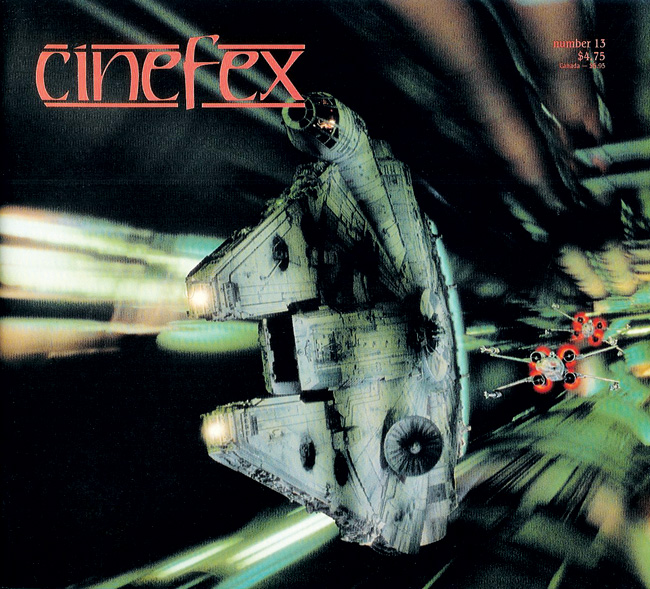
Return of the Jedi: Jedi Journal: After dazzling audiences worldwide with the first two installments in his Star Wars saga, George Lucas set out to surpass even himself with Return of the Jedi. Doing so involved not only bringing the middle trilogy to a satisfying and dramatic conclusion, but also mustering forth the considerable capabilities of his oft-awarded effects facility - Industrial Light & Magic. Since the latest Star Wars entry involved more effects shots - and of greater complexity - than either of its two predecessors, and since the work would be compressed into a somewhat shorter time frame, it was decided to split ILM into three primary effects units. At the helm of each was a seasoned Star Wars veteran - Richard Edlund,Dennis Muren and Ken Ralston. As the postproduction effort progressed, each supervisor recorded a month-by-month account of the work as it developed and changed, producing in the process a fascinating account of how a major effects production comes together - the anticipation and planning, the crushing workload, the delights and disappointments. Edited by Don Shay
Return of the Jedi: Jedi Journal: After dazzling audiences worldwide with the first two installments in his Star Wars saga, George Lucas set out to surpass even himself with Return...
more

On cover:
Issue 14

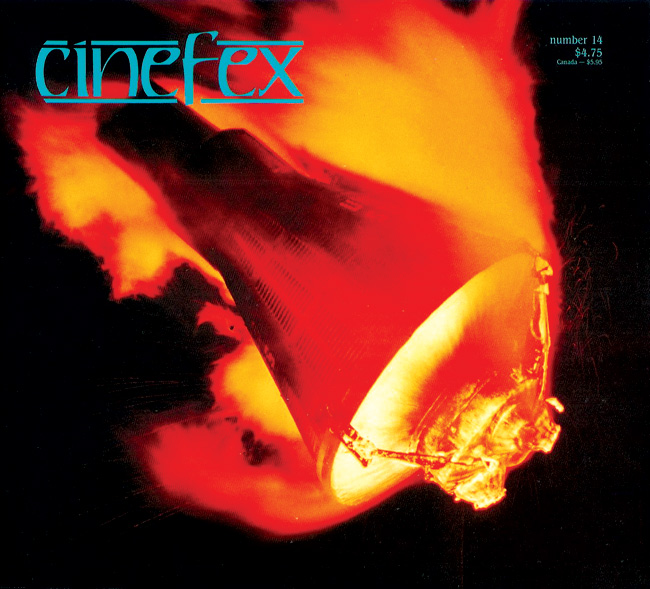
Low-Tech Effects - The Right Stuff: When Phillip Kaufman set out to film The Right Stuff, he was faced with the task of creating believable flying effects - of familiar real-world aircraft and space vessels - that could be convincingly intercut with Air Force and NASA documentary footage. To accomplish the job, he engaged experimental filmmaker Jordan Belson and USFX effects supervisor Gary Gutierrez. What followed was a two-year odyssey of discovery and growth, during which all three found that high technology did not always produce high satisfaction. Article by Adam Eisenberg
Brainstorm - Getting the Cookie at the End: More than a decade after Silent Running, effects maestro Douglas Trumbull landed his second directing assignment on Brainstorm, only to become embroiled in a debilitating two-year struggle just to see the film completed. A key element in the postproduction effort was the creation of a point-of-view representation of the death experience - an eerie journey through a figurative heaven and hell that dominates the film's climax. Trumbull, effects supervisor Alison Yerxa and six other members of the crew, discuss the unique production. Article by Brad Munson
Twilight Zone - The Movie: Shadow and Substance: With Twilight Zone - The Movie, four top-notch directors joined forces to extract the essence of Rod Serling's ever-popular teleseries and transform it into a theatrical experience worthy of its progenitor - an anthology of filmic fantasies, old and new, ranging from the poignant to the harrowing. Though special effects, in general, were to take a back seat, two of the film's episodes featured exuberant displays of makeup prowess and postproduction opticals - discussed in detail by the principals involved. Article by Don Shay and Paul Sammon
Brainstorm - Getting the Cookie at the End: More than a decade after Silent Running, effects maestro Douglas Trumbull landed his second directing assignment on Brainstorm, only to become embroiled in a debilitating two-year struggle just to see the film completed. A key element in the postproduction effort was the creation of a point-of-view representation of the death experience - an eerie journey through a figurative heaven and hell that dominates the film's climax. Trumbull, effects supervisor Alison Yerxa and six other members of the crew, discuss the unique production. Article by Brad Munson
Twilight Zone - The Movie: Shadow and Substance: With Twilight Zone - The Movie, four top-notch directors joined forces to extract the essence of Rod Serling's ever-popular teleseries and transform it into a theatrical experience worthy of its progenitor - an anthology of filmic fantasies, old and new, ranging from the poignant to the harrowing. Though special effects, in general, were to take a back seat, two of the film's episodes featured exuberant displays of makeup prowess and postproduction opticals - discussed in detail by the principals involved. Article by Don Shay and Paul Sammon
Low-Tech Effects - The Right Stuff: When Phillip Kaufman set out to film The Right Stuff, he was faced with the task of creating believable flying effects - of familiar...
more

Issue 15

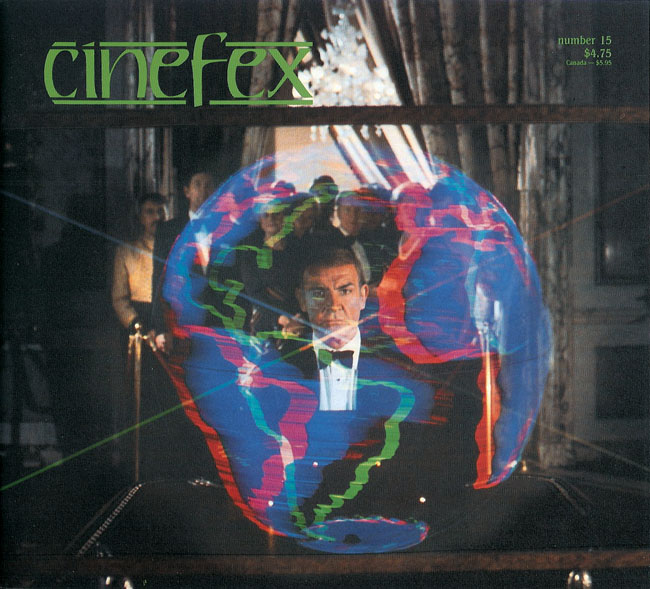
David Dryer - Never Say Never Again: Never Say Never Again - the maverick James Bond film starring the original 007, Sean Connery - emerged this fall as one of the series' strongest entries. To helm its postproduction opticals, producer Jack Schwartzman selected Oscar nominee David Dryer. Dryer - who utilized the high-tech facilities of Apogee - details the techniques employed to produce the pivotal cruise missle hijacking, the holographic videogame confrontation between Bond and Largo, and other less apparent illusions. Interview by Don Shay
The Day After: Waging a Four-Minute War: In a storm of protest and praise, ABC's video presentation of The Day After descended upon the American public as a grim reminder of the potential horrors of nuclear weaponry. Recalling the highly-charged atmosphere of creative enthusiasm and emotional abhorrence, effects supervisor Robert Blalack and members of his Praxis Film Works team discuss their involvement on the film augmented by Mike Minkow of Movie Magic; and with additional recollections from director Nicholas Meyer, his predecessor Robert Butler, and production designer Peter Wooley. Article by Adam Eisenberg
Photographs and Memories - Ralph Hammeras: In a career spanning almost half a century, effects pioneer Ralph Hammeras worked on some one thousand motion pictures - garnering, in the process, four Academy Award nominations and one Oscar. As recounted in his own words - put to paper nearly twenty years ago - Hammeras reminisces about his early days in the film business, his development of the 'glass shot' and rear process photography, and his work on such significant effects productions as The Lost World, Just Imagine and 20,000 Leagues Under the Sea. Edited by Don Shay
The Day After: Waging a Four-Minute War: In a storm of protest and praise, ABC's video presentation of The Day After descended upon the American public as a grim reminder of the potential horrors of nuclear weaponry. Recalling the highly-charged atmosphere of creative enthusiasm and emotional abhorrence, effects supervisor Robert Blalack and members of his Praxis Film Works team discuss their involvement on the film augmented by Mike Minkow of Movie Magic; and with additional recollections from director Nicholas Meyer, his predecessor Robert Butler, and production designer Peter Wooley. Article by Adam Eisenberg
Photographs and Memories - Ralph Hammeras: In a career spanning almost half a century, effects pioneer Ralph Hammeras worked on some one thousand motion pictures - garnering, in the process, four Academy Award nominations and one Oscar. As recounted in his own words - put to paper nearly twenty years ago - Hammeras reminisces about his early days in the film business, his development of the 'glass shot' and rear process photography, and his work on such significant effects productions as The Lost World, Just Imagine and 20,000 Leagues Under the Sea. Edited by Don Shay
David Dryer - Never Say Never Again: Never Say Never Again - the maverick James Bond film starring the original 007, Sean Connery - emerged this fall as one of...
more

Issue 16
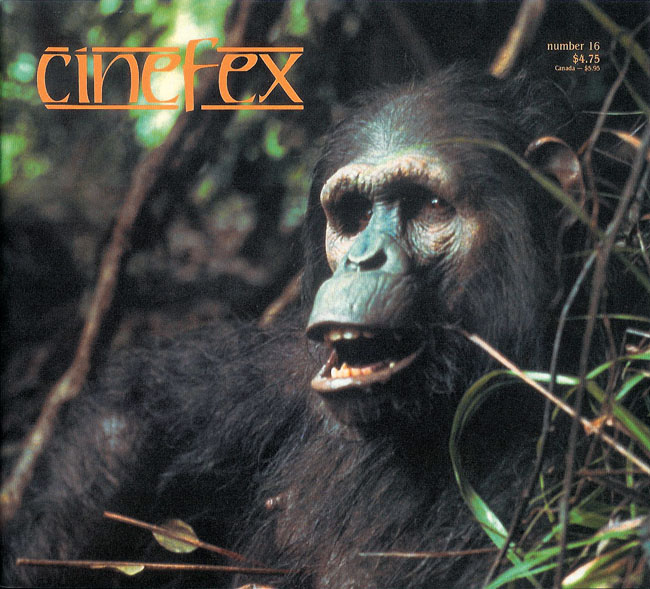
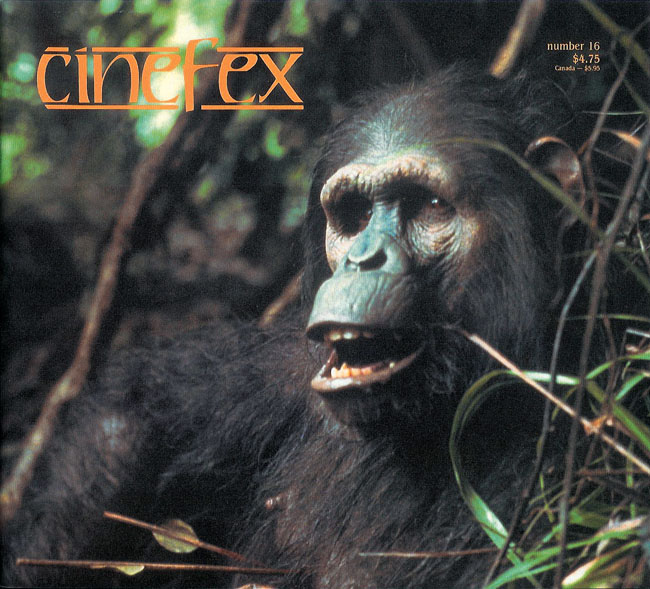
Rick Baker - Maker of Monsters, Master of the Apes: When ten-year-old Rick Baker first began experimenting with the most basic of makeup materials, his emerging passion for the sorts of illusions which could be wrought with these arcane substances was decidedly out of the ordinary. Motion picture makeup - the kind that transforms actors into monsters, aliens or even animals - was not at all the stellar occupation it has come to be; and at the time, there was little in the way of instructional materials an enthusiastic novice could draw upon, let alone a clearly marked path toward professional involvement. Baker's unwavering dedication, coupled with a single-minded pursuit of excellence, was to serve him well, however - vaulting him past such obstacles to a position of prominence in a burgeoning career field in which he now has few peers. From the early, low-budget efforts of Octoman and Schlock, through It's Alive and The Incredible Melting Man, and eventually on to loftier assignments in Star Wars, The Incredible Shrinking Woman and the lamentable King Kong remake, Baker honed his skills and developed his talents - ultimately reaching full maturity in response to the diverse challenges of An American Werewolf in London, Videodrome and Greystoke. From simple pie dough makeups to the most complicated of bodily transformation, Baker delves into his life and work, offering an incisive look at the artist and his art. Article by Jordan Fox
Rick Baker - Maker of Monsters, Master of the Apes: When ten-year-old Rick Baker first began experimenting with the most basic of makeup materials, his emerging passion for the sorts...
more

1984
Issue 17


Ghostbusters: After a stellar seven-year association with the Lucasfilm family, four-time Oscar-winner Richard Edlund departed Industrial Light & Magic to establish his own effects organization at Entertainment Effects Group. Ghostbusters - his first independent assignment - presented him with the challenge of producing nearly two hundred varied and complex effects shots in considerably less than a year. Before he could even begin, however, the facility - formerly operated by Douglas Trumbull and Richard Yuricich - had to be restructured, additional equipment had to be designed and built, and a top-notch crew had to be assembled from the ground up. Edlund details the problems involved and - together with key members of his production unit - discusses the magic that went into Ivan Reitman's supernatural comedy. Article by Adam Eisenberg
The Last Starfighter - Imagery Wrought in the Total Forge: When John Whitney Jr. and Gary Demos established Digital Productions in 1981, they did so with an eye towards building a facility that would revolutionize the field of computer generated imagery and at the same time introduce to the film industry a viable alternative to optical effects and motion control photography. Armed with the Cray X-MP - the world's most powerful computer - they turned their high tech talents loose on The Last Starfighter, generating an unprecedented twenty-five minutes of digital scene simulation. Whitney and Demos discuss the unique nature and capabilities of Digital Productions, while individual members of the simulation team delve into the specifics of their premiere film - featuring, among other things, some of the most complex computer imagery every produced. Article by Peter Sorensen
The Last Starfighter - Imagery Wrought in the Total Forge: When John Whitney Jr. and Gary Demos established Digital Productions in 1981, they did so with an eye towards building a facility that would revolutionize the field of computer generated imagery and at the same time introduce to the film industry a viable alternative to optical effects and motion control photography. Armed with the Cray X-MP - the world's most powerful computer - they turned their high tech talents loose on The Last Starfighter, generating an unprecedented twenty-five minutes of digital scene simulation. Whitney and Demos discuss the unique nature and capabilities of Digital Productions, while individual members of the simulation team delve into the specifics of their premiere film - featuring, among other things, some of the most complex computer imagery every produced. Article by Peter Sorensen
Ghostbusters: After a stellar seven-year association with the Lucasfilm family, four-time Oscar-winner Richard Edlund departed Industrial Light & Magic to establish his own effects organization at Entertainment Effects Group. Ghostbusters...
more

Issue 18
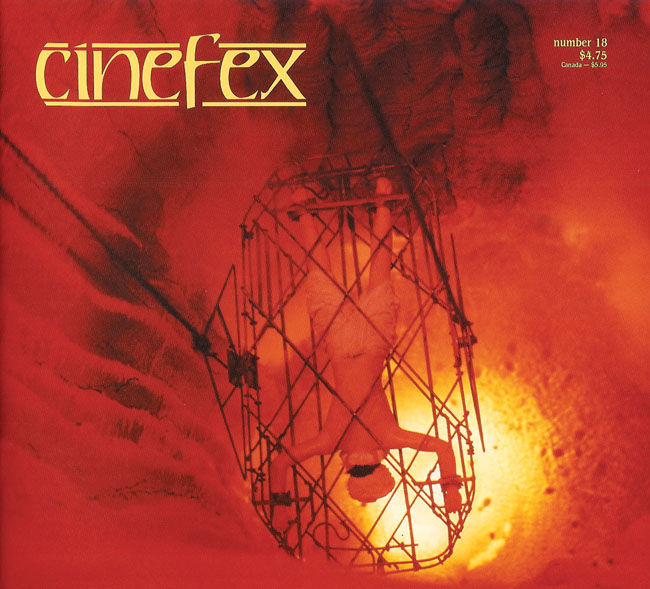
Indiana Jones and the Temple of Doom: Hell and High Water: Indiana Jones and the Temple of Doom marks the second blockbuster association between executive producer George Lucas and director Steven Spielberg. Unlike Raiders of the Lost Ark, which - with the exception of its cosmic finale - relied primarily on dazzling stuntwork for its thrills and chills, many of the key sequences in the second Indiana Jones adventure were made possible only through the employment of elaborate visual effects. From miniature airplanes and mine cars to large-scale lava and water effects, the cinemagicians of Industrial Light & Magic stretched the limits of their experience and expertise to produce some 140 effects shots for the consummate cliffhanger. Three-time Oscar-winning effects supervisor Dennis Muren discusses the project in detail, aided and abetted by numerous members of his highly-specialized team. Article by Robert P. Everett
Star Trek III: The Search for Spock: The Final Voyage of the Starship 'Enterprise': Concurrent with their involvement in Indiana Jones, the artists and technicians of Industrial Light & Magic were also at work on a vastly different project - their second foray into Star Trek's final frontier. In Star Trek III: The Search for Spock, Oscar-winning effects supervisor Ken Ralston and his team were called upon to create alien creatures, several new spacecraft, a mammoth orbiting drydock, planetary surfaces for Genesis and Vulcan - and most memorable, the destruction of the starship Enterprise. Ralston and key members of the effects unit detail the challenges involved and the techniques employed in achieving these and other cinematic wonders. Article by Brad Munson
Star Trek III: The Search for Spock: The Final Voyage of the Starship 'Enterprise': Concurrent with their involvement in Indiana Jones, the artists and technicians of Industrial Light & Magic were also at work on a vastly different project - their second foray into Star Trek's final frontier. In Star Trek III: The Search for Spock, Oscar-winning effects supervisor Ken Ralston and his team were called upon to create alien creatures, several new spacecraft, a mammoth orbiting drydock, planetary surfaces for Genesis and Vulcan - and most memorable, the destruction of the starship Enterprise. Ralston and key members of the effects unit detail the challenges involved and the techniques employed in achieving these and other cinematic wonders. Article by Brad Munson
Indiana Jones and the Temple of Doom: Hell and High Water: Indiana Jones and the Temple of Doom marks the second blockbuster association between executive producer George Lucas and director...
more

Issue 19
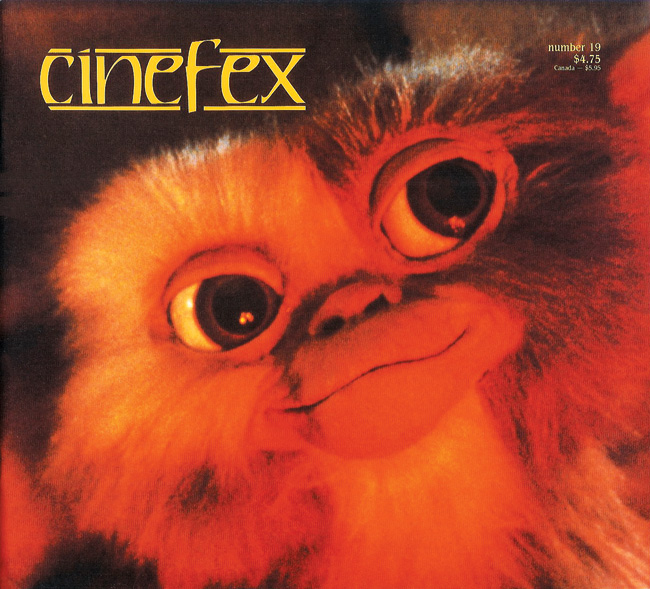
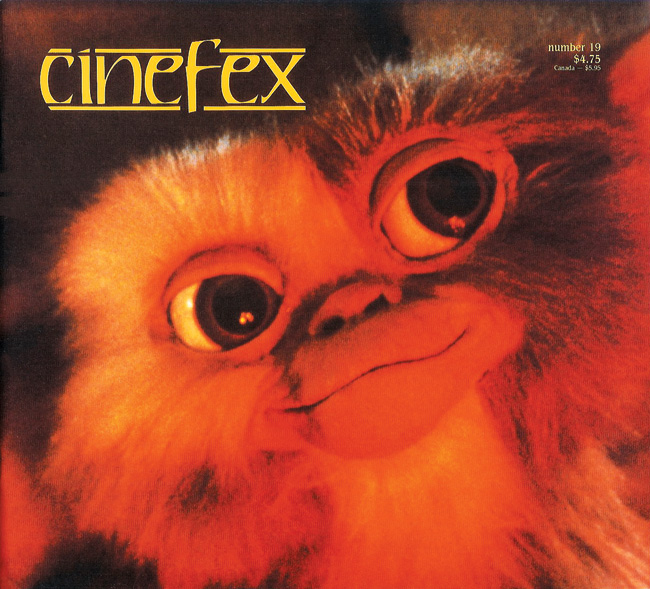
Gremlins: Never Feed Them After Midnight: A stylishly quirky master of the cult film, director Joe Dante took a giant step forward into mainstream filmmaking with Gremlins, a savagely witty fairy tale and resounding boxoffice success. To an extent beyond that of any recent film, Gremlins relied almost as much on its variously conceived mechanical creatures as it did on its live performers. With contributions from Joe Dante, producer Michael Finnell and others, mogwai and gremlin creator Chris Walas unveils the story behind the year's most remarkable cinematic newcomers. Article by Paul M. Sammon
Across the Eighth Dimension with Buckaroo Banzai: Overflowing with bizarre concepts and off-the-wall humor, The Adventures of Buckaroo Banzai demanded an equally off-centered approach to its visual effects. With this in mind, effects supervisor Michael Fink was given the task of organizing and coordinating the activities of three separate facilities, all engaged in providing footage of organic spaceships and interdimensional environments. With an overview by director W.D. Richter, Fink elaborates on the project, with additional input from Hoyt Yeatman and Keith Shartle of Dream QuestImages, Peter Kuran of VCE, Inc., and John Scheele of Greenlite Effects. Article by Nora Lee
Dreamscape: What Dreams Are Made Of: Creating a low-budget dream world was often a nightmare for the effects personnel involved in Dreamscape. Visual effects supervisor Peter Kuran details the creation of surrealistic nuclear explosions and post-holocaust environments; special makeup artist Craig Reardon outlines the construction of a full-size snakeman and various radiation-burned bomb victims; and camerman James Aupperle discusses his stop-motion animation in the film. Article by Adam Eisenberg
Across the Eighth Dimension with Buckaroo Banzai: Overflowing with bizarre concepts and off-the-wall humor, The Adventures of Buckaroo Banzai demanded an equally off-centered approach to its visual effects. With this in mind, effects supervisor Michael Fink was given the task of organizing and coordinating the activities of three separate facilities, all engaged in providing footage of organic spaceships and interdimensional environments. With an overview by director W.D. Richter, Fink elaborates on the project, with additional input from Hoyt Yeatman and Keith Shartle of Dream QuestImages, Peter Kuran of VCE, Inc., and John Scheele of Greenlite Effects. Article by Nora Lee
Dreamscape: What Dreams Are Made Of: Creating a low-budget dream world was often a nightmare for the effects personnel involved in Dreamscape. Visual effects supervisor Peter Kuran details the creation of surrealistic nuclear explosions and post-holocaust environments; special makeup artist Craig Reardon outlines the construction of a full-size snakeman and various radiation-burned bomb victims; and camerman James Aupperle discusses his stop-motion animation in the film. Article by Adam Eisenberg
Gremlins: Never Feed Them After Midnight: A stylishly quirky master of the cult film, director Joe Dante took a giant step forward into mainstream filmmaking with Gremlins, a savagely witty...
more

Issue 20


Jupiter Revisited - The Odyssey of '2010': Sixteen years ago, 2001: A Space Odyssey was launched into the cinematic firmament - a glimmering enigma which, among other things, promptly established a new aesthetic, as well as a whole new set of ground rules for motion picture special effects. Nearly a decade would pass before Star Wars and Close Encounters of the Third Kind, using computerized motion control photography and advanced compositing techniques, would begin to close the technological gap established by 2001. When Arthur C. Clarke published his much anticipated sequel 2010: Odyssey Two in 1982, it was reasonable to assume that it would soon find its way onto the screen, with the full force of contemporary state-of-the-art movie magic brought to bear on its complex effects requirements. Rising to the challenge were producer-writer-director Peter Hyams, futurist designer Syd Mead and visual effects supervisor Richard Edlund. From actualizing a Russian interplanetary spaceship to devising an authentic-looking representation of Jupiter's turbulent surface, the 2010 effects unit fulfilled the demands of the production and in the process established a fresh new look in simulated space photography. Article by Don Shay
Jupiter Revisited - The Odyssey of '2010': Sixteen years ago, 2001: A Space Odyssey was launched into the cinematic firmament - a glimmering enigma which, among other things, promptly established...
more

1985
Issue 21

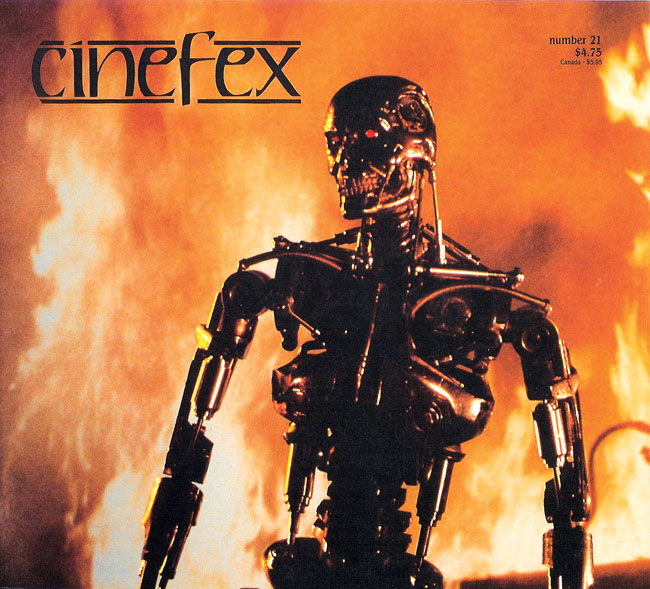
The Terminator: When writer-director James Cameron first conceived of The Terminator, it was little more than a visceral image of a human cyborg emerging from a fire in its basic skeletal form. What it became was a modestly-budgeted blockbuster. To bring his image to life, Cameron engaged the services of Stan Winston - whose seasoned team of makeup and mechanical effects experts created the full-size robotic skeleton, as well as several lifelike representations of actor Arnold Schwarzenegger. For futuristic post-holocaust views of Los Angeles, plus contemporary pyrotechnics and stop-motion effects, the expertise and talents of Fantasy II were brought to bear. With minimal funds, but a wealth of creativity and enthusiasm, The Terminator's effects units helped transform Cameron's searing image into both a thrill-a-minute adventure and a major boxoffice event. Article by Jennifer Benidt
The Shape of 'Dune': Despite enormous popularity as a novel, twenty years would elapse before Frank Herbert's Dune would make the quantum leap from printed page to cinematic reality. The imposing challenge of adapting the widely-read cult classic - a saga rivaling the novel itself in epic proportion - would ultimately be met by writer-director David Lynch. In consort with cinematographer Freddie Francis, production designer Tony Masters, and a battery of high-powered effects supervisors including Carlo Rambaldi, Albert Whitlock, Barry Nolan, Kit West and Brian Smithies, Lynch would labor diligently for three-and-a-half years to bring his vision of Herbert's exotic work to life. From the worm-infested deserts of Arrakis to the murky decadence of Giedi Prime, Lynch and his production unit combineda wealth of experience with fresh innovation to weave the richly-textured tapestry of Dune. Edited by Janine Pourroy and Don Shay
The Shape of 'Dune': Despite enormous popularity as a novel, twenty years would elapse before Frank Herbert's Dune would make the quantum leap from printed page to cinematic reality. The imposing challenge of adapting the widely-read cult classic - a saga rivaling the novel itself in epic proportion - would ultimately be met by writer-director David Lynch. In consort with cinematographer Freddie Francis, production designer Tony Masters, and a battery of high-powered effects supervisors including Carlo Rambaldi, Albert Whitlock, Barry Nolan, Kit West and Brian Smithies, Lynch would labor diligently for three-and-a-half years to bring his vision of Herbert's exotic work to life. From the worm-infested deserts of Arrakis to the murky decadence of Giedi Prime, Lynch and his production unit combineda wealth of experience with fresh innovation to weave the richly-textured tapestry of Dune. Edited by Janine Pourroy and Don Shay
The Terminator: When writer-director James Cameron first conceived of The Terminator, it was little more than a visceral image of a human cyborg emerging from a fire in its basic...
more

Issue 22

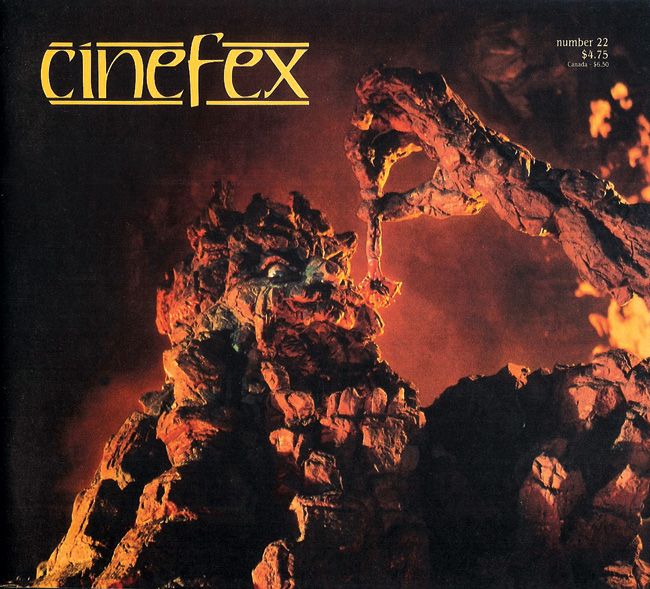
Return to Oz: It all started eighty-five years ago when L. Frank Baum first captured the hearts and imaginations of children with The Wonderful Wizard of Oz. The book's literary success spawned dozens of stage and screen excursions to the Land of Oz, marked most notably by MGM's immortal classic. Repudiating the popular conception of singing and dancing munchkins and vaudevillian backdrops, Walt Disney Productions and director Walter Murch have reexplored Baum's familiar and beloved fantasy world in a dedicated new adaptation - Return to Oz. Producers Gary Kurtz and Paul Maslansky, opticals expert Zoran Perisic, creature designer Lyle Conway and Claymation innovator Will Vinton - together with other members of the Oz team - discuss in detail the special brand of wizardry involved in bringing Dorothy Gale's time-honored adventures once again to life. Article by Brad Munson
Baby: Bringing up Baby: In the animal-adventure genre there is nothing new under the sun - or is there? For Touchstone Films, the novel twist of casting a most unusual fauna in the title role of Baby was inspiration for the telling of an old tale in a decidedly new way. The Isidoro Raponi-designed infant brontosaurus star was born cinematically in the rain forests of Africa's Ivory Coast following an arduous three-year gestation period. For director B.W.L. Norton and producer Jonathan Taplin, the trials and tribulations of bringing the $14 million production to life involved an exhausting - often harrowing - labor. And the challenge of creating high-tech special effects in a low-tech Third World country furnished all involved with more than their share of real-life thrills and chills. Article by Howard E. Green
Baby: Bringing up Baby: In the animal-adventure genre there is nothing new under the sun - or is there? For Touchstone Films, the novel twist of casting a most unusual fauna in the title role of Baby was inspiration for the telling of an old tale in a decidedly new way. The Isidoro Raponi-designed infant brontosaurus star was born cinematically in the rain forests of Africa's Ivory Coast following an arduous three-year gestation period. For director B.W.L. Norton and producer Jonathan Taplin, the trials and tribulations of bringing the $14 million production to life involved an exhausting - often harrowing - labor. And the challenge of creating high-tech special effects in a low-tech Third World country furnished all involved with more than their share of real-life thrills and chills. Article by Howard E. Green
Return to Oz: It all started eighty-five years ago when L. Frank Baum first captured the hearts and imaginations of children with The Wonderful Wizard of Oz. The book's literary...
more

Issue 23
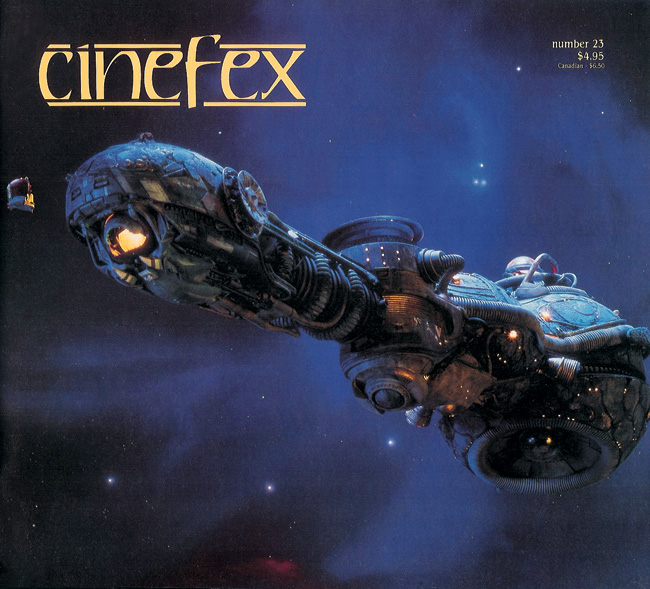
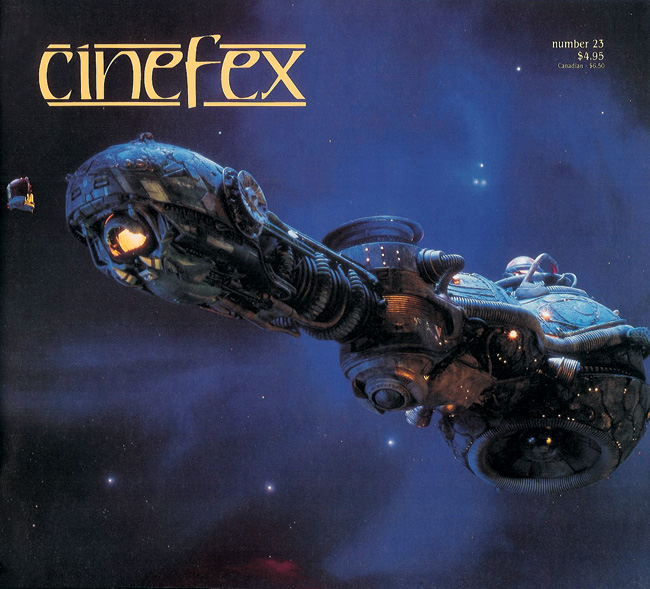
Explorers: The Stuff That Dreams Are Made Of: Every kid has dreams of adventure by way of a backyard fort or makeshift treehouse. In Joe Dante's summertime jaunt, Explorers, the dream comes true. Only this time the journey begins when a homemade spaceship devised by three young boys really does take off for parts unknown and brings the trio face-to-face with some hilariously offbeat Rob Bottin-designed aliens. With the effects expertise of Industrial Light & Magic and the computer-generated animation of Omnibus Computer Graphics, Dante and company launched a $23 million expedition into the cinematic firmament. Article by Adam Eisenberg
Lifeforce: Baring the Soul of 'Lifeforce': Bizarre makeup and unusual opticals are prime elements of the modern horror or science fiction film, and director Tobe Hooper's Lifeforce - an incredible combination of the two genres - is replete with both. Keeping up with an effects-a-minute pace was no easy task for the international crew, and John Dykstra and key members of his Apogee organizaion discuss challenges faced on the visual effects front. From conventional model photography to innovative laser applications, the production team concocted an assortment of illusions to help bring Colin Wilson's tale of soul-snatching vampires to life. Article by Glenn Campbell
Shooting for an 'A' on 'My Science Project': Screenwriter Jonathan Betuel was certain of two things while shopping his My Science Project script around Hollywood - he wanted to direct the film, and it had to feature a terrifying tyrannosaurus rex sequence. Walt Disney Productions agreed and gave Betuel the directorial reins for his fantasy-adventure yarn about a high school science experiment gone awry. Along with effects supervisor John Scheele, dinosaur-builder Doug Beswick and other members of the effects ensemble, first-time director Betuel reflects upon the unlikely logistics of getting a prehistoric carnivore into the school gymnasium. Article by Stephen Rebello
Lifeforce: Baring the Soul of 'Lifeforce': Bizarre makeup and unusual opticals are prime elements of the modern horror or science fiction film, and director Tobe Hooper's Lifeforce - an incredible combination of the two genres - is replete with both. Keeping up with an effects-a-minute pace was no easy task for the international crew, and John Dykstra and key members of his Apogee organizaion discuss challenges faced on the visual effects front. From conventional model photography to innovative laser applications, the production team concocted an assortment of illusions to help bring Colin Wilson's tale of soul-snatching vampires to life. Article by Glenn Campbell
Shooting for an 'A' on 'My Science Project': Screenwriter Jonathan Betuel was certain of two things while shopping his My Science Project script around Hollywood - he wanted to direct the film, and it had to feature a terrifying tyrannosaurus rex sequence. Walt Disney Productions agreed and gave Betuel the directorial reins for his fantasy-adventure yarn about a high school science experiment gone awry. Along with effects supervisor John Scheele, dinosaur-builder Doug Beswick and other members of the effects ensemble, first-time director Betuel reflects upon the unlikely logistics of getting a prehistoric carnivore into the school gymnasium. Article by Stephen Rebello
Explorers: The Stuff That Dreams Are Made Of: Every kid has dreams of adventure by way of a backyard fort or makeshift treehouse. In Joe Dante's summertime jaunt, Explorers, the...
more

Issue 24
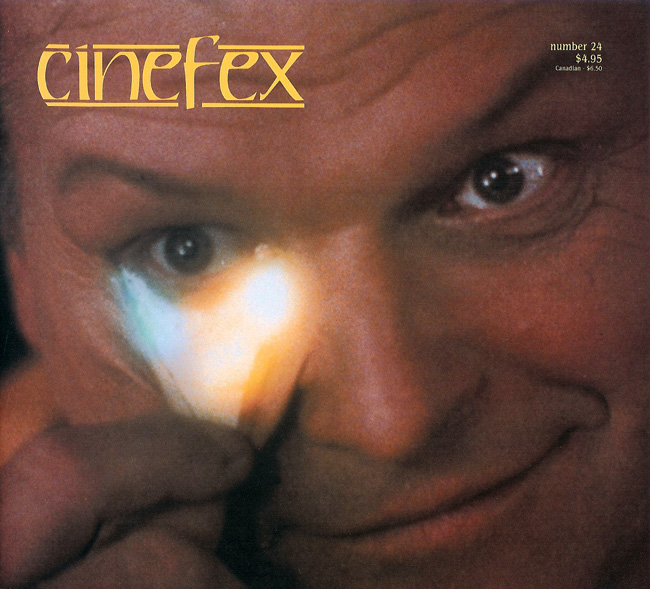
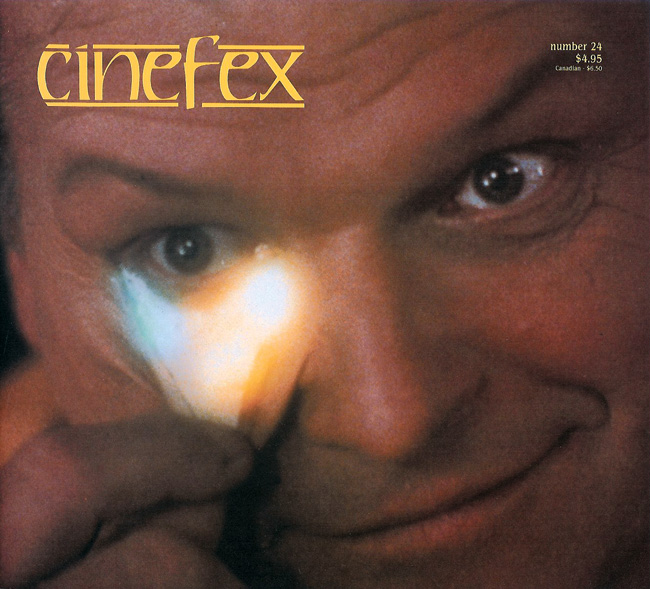
Creating the Wonder of 'Cocoon': Without benefit of unbridled violence, gross-out humor or food fights - apparent prerequisites for contemporary boxoffice success - Cocoon seemed a decidedly tame entry into the summer filmgoing sweepstakes. Not to mention the fact that in these times of youth-oriented fare, its principal cast consisted largely of veteran performers well into their Social Security years. But in director Ron Howards' hands, the Zanuck/Brown production - with its predominant emphasis on character and heart - finished a strong third among the season's boxoffice attractions. Helping to create the magic behind what Howard jokingly dubbed 'Close Encounters on Golden Pond' were the diversely-talented cinemagicians of Industrial Light & Magic, Cannom Creature Effects and Robert Short Productions who - separately and collectively - produced everything from lifelike mechanical dolphins to glowing extraterrestrials to flying saucers from distant worlds. Article by Jody Duncan Shay
Backyard Adventures - Spielberg Style: When Steven Spielberg's Amblin Productions first approached Industrial Light & Magic with a request to purvey the few, minimal effects shots needed for The Goonies and Back to the Future, the proposal seemed innocent enough. The premier facility was well-accustomed to orchestrating visual effects by the hundreds for Lucasfilm's intergalactic space epics. But the fast-paced, tandem production scheduling of Amblin's earthbound adventures called for some decidedly different approaches - and compelled the already well-occupied ILM staff into a whirlwind of productivity. And although neither Goonies nor Back to the Future is considered a 'major effects film', each features several well-placed 'major effects'. Seasoned veterans of illusion Micheal McAlister, Ken Ralston and other members of Industrial Light & Magic - along with the films' special makeup experts - discuss life in the special effects fast lane and the ensuing challenges thereof. Article by Janine Pourroy
Backyard Adventures - Spielberg Style: When Steven Spielberg's Amblin Productions first approached Industrial Light & Magic with a request to purvey the few, minimal effects shots needed for The Goonies and Back to the Future, the proposal seemed innocent enough. The premier facility was well-accustomed to orchestrating visual effects by the hundreds for Lucasfilm's intergalactic space epics. But the fast-paced, tandem production scheduling of Amblin's earthbound adventures called for some decidedly different approaches - and compelled the already well-occupied ILM staff into a whirlwind of productivity. And although neither Goonies nor Back to the Future is considered a 'major effects film', each features several well-placed 'major effects'. Seasoned veterans of illusion Micheal McAlister, Ken Ralston and other members of Industrial Light & Magic - along with the films' special makeup experts - discuss life in the special effects fast lane and the ensuing challenges thereof. Article by Janine Pourroy
Creating the Wonder of 'Cocoon': Without benefit of unbridled violence, gross-out humor or food fights - apparent prerequisites for contemporary boxoffice success - Cocoon seemed a decidedly tame entry into...
more

1986
Issue 25
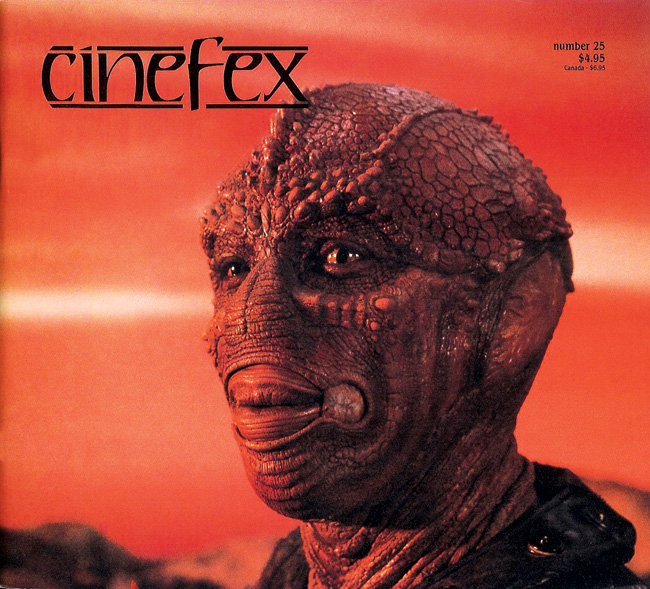
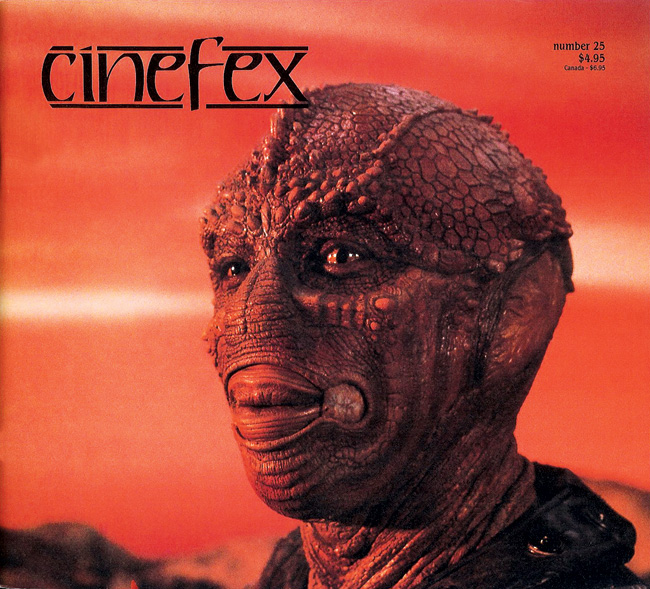
Behind the Lines of 'Enemy Mine': Although Barry Longyear's futuristic story of survival and friendship in an unwelcoming environment seemed an ideal film property, the process of bringing Enemy Mine to the screen would prove anything but ideal. The need for intricate alien makeups, bizarre scenery and dogfighting spacecraft automatically earmarked the project as an especially challenging one - rendered even more so by the replacement of the original director in mid-production. Ultimately, however, the film would come together under the direction of Wolfgang Petersen who orchestrated both the demanding live-action shoot and an international assemblage of multitalented effects people. Article by Janine Pourroy
Der Trickfilm - A Survey of German Special Effects: During the opening years of the twentieth century, when the art of filmmaking was being developed on an international scale, the German cinema promptly established a sungular identity for itself - an identity shaped largely by the fact that its prime innovators seemed possessed by an insatiable fascination with the fantastic. Tasked with subjects ranging from epic fantasy to futuristic science fiction, German technicians were among the first to explore and exploit the magical capabilities of the motion picture camera. Article by Rolf Giesen
Fright Night: Writer-director Tom Holland conceived of Fright Night as a contemporary tribute to the traditional vampire film, complete with all affectations of the genre. But instead of employing the simplistic techniques of yore, Holland was determined to utilize state-of-the-art special effects to their fullest. Undaunted by a relatively meager budget, Holland and Columbia Pictures turned toRichard Edlund and Boss Film Corporation with a unique challenge to produce an array of high-quality illusions - everything from flying bats to snarling man-beasts - all for an unprecedented bargain price. Article by Jennifer Benidt and Janine Pourroy
Der Trickfilm - A Survey of German Special Effects: During the opening years of the twentieth century, when the art of filmmaking was being developed on an international scale, the German cinema promptly established a sungular identity for itself - an identity shaped largely by the fact that its prime innovators seemed possessed by an insatiable fascination with the fantastic. Tasked with subjects ranging from epic fantasy to futuristic science fiction, German technicians were among the first to explore and exploit the magical capabilities of the motion picture camera. Article by Rolf Giesen
Fright Night: Writer-director Tom Holland conceived of Fright Night as a contemporary tribute to the traditional vampire film, complete with all affectations of the genre. But instead of employing the simplistic techniques of yore, Holland was determined to utilize state-of-the-art special effects to their fullest. Undaunted by a relatively meager budget, Holland and Columbia Pictures turned toRichard Edlund and Boss Film Corporation with a unique challenge to produce an array of high-quality illusions - everything from flying bats to snarling man-beasts - all for an unprecedented bargain price. Article by Jennifer Benidt and Janine Pourroy
Behind the Lines of 'Enemy Mine': Although Barry Longyear's futuristic story of survival and friendship in an unwelcoming environment seemed an ideal film property, the process of bringing Enemy Mine...
more

Issue 26
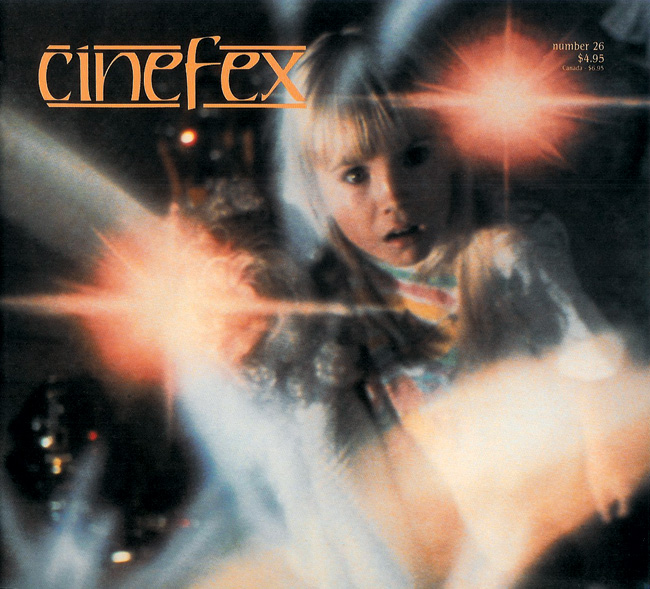
Poltergeist II: To Hell and Back: In 1982, all hell broke loose in the Freeling household. Steven Spielberg's production of Poltergeist recounted the chilling tale of a family turned upside-down by ghostly goings-on engineered and executed by Oscar-winner Richard Edlund and his visual effects team at Industrial Light & Magic. Now, four years later, Poltergeist II finds the beleaguered Freelings once again embroiled in a multidimensional melee - this time without producer Spielberg or Industrial Light & Magic, but with Edlund still at the visual effects helm. Faced with the challenge of surpassing his own previous efforts, Edlund and his Boss Film Corporation - comprised of many veterans from the earlier production - redefined the nature of supernatural filmmaking, bringing to life in the process an array of horrific new phantasms conceived by surrealist designer H.R. Giger. Article by Nora Lee and Janine Pourroy
Young Sherlock Holmes: Anything But Elementary: Heading the ranks of cinematic supersleuths for decades has been the constant, ever-brilliant epitome of logic and clever deduction - Sherlock Holmes. As the latest entry in the Holmesian film chronicles, Young Sherlock Holmes - directed by Barry Levinson for Amblin Productions - presents a portrait of the fledgling detective as a teenager obsessed by a string of baffling murders. Veteran physical effects expert Kit West, first-time animatronics supervisor Stephen Norrington and the cinemagicians at Industrial Light & Magic were called upon to create the film's innovative special effects - ranging from flying machines and murderous hatracks to bizarre hallucinations requiring high-tech computer graphics, go-motion puppet animation and sophisticated rod puppeteering. Article by Jody Duncan Shay
Young Sherlock Holmes: Anything But Elementary: Heading the ranks of cinematic supersleuths for decades has been the constant, ever-brilliant epitome of logic and clever deduction - Sherlock Holmes. As the latest entry in the Holmesian film chronicles, Young Sherlock Holmes - directed by Barry Levinson for Amblin Productions - presents a portrait of the fledgling detective as a teenager obsessed by a string of baffling murders. Veteran physical effects expert Kit West, first-time animatronics supervisor Stephen Norrington and the cinemagicians at Industrial Light & Magic were called upon to create the film's innovative special effects - ranging from flying machines and murderous hatracks to bizarre hallucinations requiring high-tech computer graphics, go-motion puppet animation and sophisticated rod puppeteering. Article by Jody Duncan Shay
Poltergeist II: To Hell and Back: In 1982, all hell broke loose in the Freeling household. Steven Spielberg's production of Poltergeist recounted the chilling tale of a family turned upside-down...
more

Issue 27

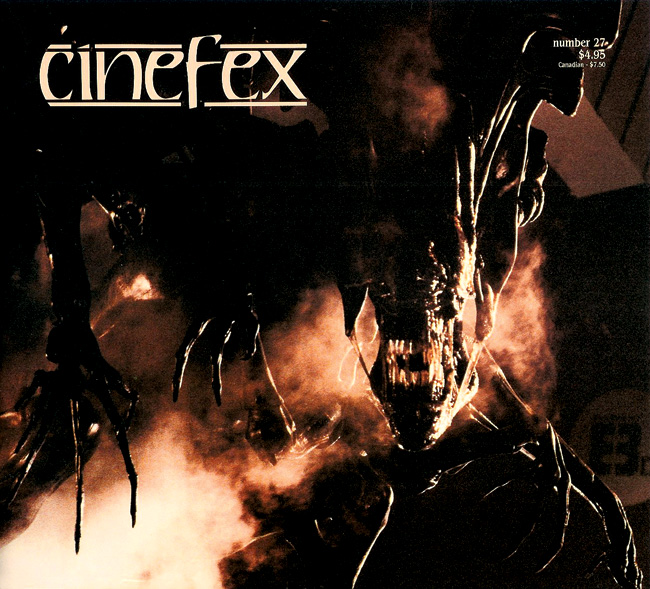
Aliens: In the seven years since its release, Ridley Scott's Alien has endured as the quintessential science fiction horror film - a stylish thriller and box-office favorite that spawned a rash of forgettable clones but somehow defied legitimate efforts to generate a worthy sequel. A fresh approach was clearly in order, but that approach proved evasive until writer-director James Cameron was afforded the opportunity to develop his own scenaro - an action-packed roller coaster ride that succeeded admirably in retaining the essential elements of the original without being fettered by them. Despite a studio analyst's estimate that Cameron's Aliens script would cost $35 million, producer Gale Anne Hurd mounted the ambitious sequel in England - bringing it in for a remarkably frugal $18 million. Of crucial importance to the cost curtailment effort was the need to keep the film's extensive special effects from spiraling out of control. Striving for high-quality work with low-level technology, Cameron and Hurd assembled a team of professionals that included conceptual designers Syd Mead and Ron Cobb, production designer Peter Lamont, visual effects supervisors Robert Skotak and Dennis Skotak, postproduction supervisor Brian Johnson, alien effects creator Stan Winston and physical effects supervisor John Richardson. These and other effects artisans discuss in detail their work on the film and the time-pressured campaign to bring Aliens into being. Article by Don Shay
Aliens: In the seven years since its release, Ridley Scott's Alien has endured as the quintessential science fiction horror film - a stylish thriller and box-office favorite that spawned a...
more

Issue 28

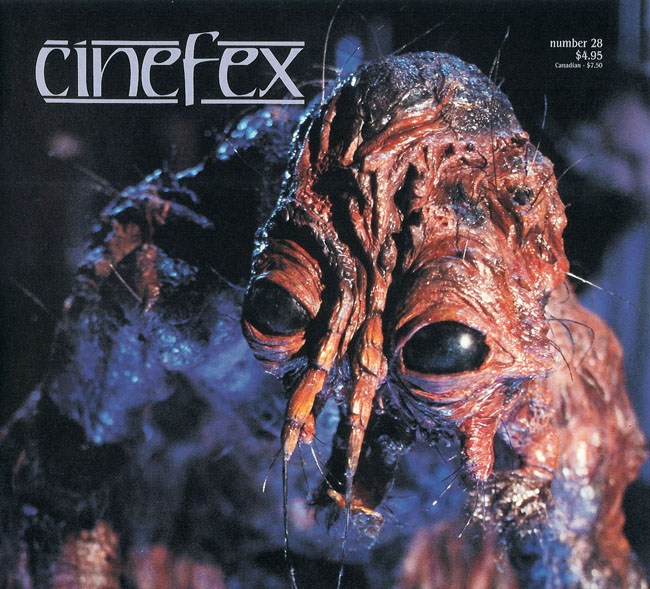
The Fly: The Fly Papers: For almost thirty years, The Fly has held a cherished place in the hearts and minds of genre film enthusiasts; so the decision to remake it was not surprising. Only its essential premise, however, would be retained. Under the direction of David Cronenberg, the story became one of a scientist whose genes are scrambled with those of a common housefly producing a mutant form that evolves incessantly into something neither human nor insect. Discussing the film and its manifold complexities are director David Cronenberg, special makeup creator Chris Walas, video effects supervisor Lee Wilson and others. Article by Tim Lucas
Big Trouble in Little China: Putting Big Trouble into Little China: For Big Trouble in Little China - a sprawling fantasy-adventure set in an imaginary world under a Chinatown - director John Carpenter needed a special effects facility that could respond to the demands of a script that called for a wide range of makeup and creature effects as well as precision opticals and animation. Rising to the task was Richard Edlund and his Boss Film Corporation who collectively produced a 2000-year-old evil magician, a flying fleshball covered with eyes, several monsters and spirits of indeterminate origin, plus a vast array of lightning effects and other illusions. Article by Janine Pourroy
Short Circuit: Building the Body Electric: The Short Circuit script had everything - adventure, humor, warmth - and John Badham knew immediately that he wanted to direct it. All it needed for success was a very special lead player - a six-foot-tall robot with an engaging personality who could drive trucks, dance disco and chase butterflies. The task of producing this singular perfomer fell to robot construction supervisor Eric Allard, futurist designer Syd Mead, puppeteer Tony Urbano and physical effects coordinator Chuck Gaspar - all of whom discuss in detail the creation of a very unique Hollywood star. Article by Jody Duncan Shay
Big Trouble in Little China: Putting Big Trouble into Little China: For Big Trouble in Little China - a sprawling fantasy-adventure set in an imaginary world under a Chinatown - director John Carpenter needed a special effects facility that could respond to the demands of a script that called for a wide range of makeup and creature effects as well as precision opticals and animation. Rising to the task was Richard Edlund and his Boss Film Corporation who collectively produced a 2000-year-old evil magician, a flying fleshball covered with eyes, several monsters and spirits of indeterminate origin, plus a vast array of lightning effects and other illusions. Article by Janine Pourroy
Short Circuit: Building the Body Electric: The Short Circuit script had everything - adventure, humor, warmth - and John Badham knew immediately that he wanted to direct it. All it needed for success was a very special lead player - a six-foot-tall robot with an engaging personality who could drive trucks, dance disco and chase butterflies. The task of producing this singular perfomer fell to robot construction supervisor Eric Allard, futurist designer Syd Mead, puppeteer Tony Urbano and physical effects coordinator Chuck Gaspar - all of whom discuss in detail the creation of a very unique Hollywood star. Article by Jody Duncan Shay
The Fly: The Fly Papers: For almost thirty years, The Fly has held a cherished place in the hearts and minds of genre film enthusiasts; so the decision to remake...
more

1987
Issue 29

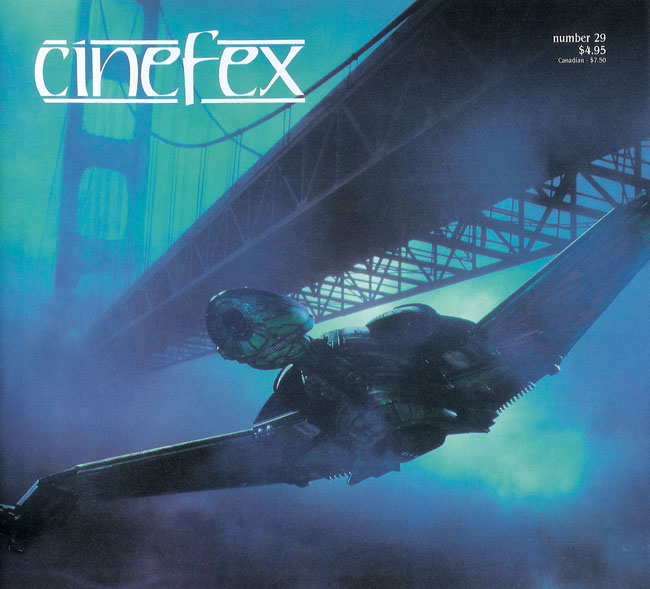
Star Trek IV: The Voyage Home: Humpback to the Future: From deep space to deep waters, Star Trek IV: The Voyage Home engages the ever-stalwart crew of the U.S.S. Enterprise in a humanistic quest that begins and ends in the twenty-third century but unfolds for the most part in modern-day San Francisco. Along with its customary quota of spaceships and transporter beams, the latest adventure called for a representation of the planet Vulcan, a unique time travel effect, major storm sequences on earth and a totally convincing simulation of two humpback whales. Article by Jody Duncan Shay
King Kong Lives: After the Fall: Forty-three years after toppling from the Empire State Building, King Kong was called upon to take an even greater tumble from the World Trade Center. Now, another decade later, the long-suffering ape has been resurrected once more for King Kong Lives - again as an ape-suited actor augmented by full-size mechanical artifacts. Discussing their work on the film are creature creator Carlo Rambaldi, production designer Peter Murton, visual effects supervisor Barry Nolan, and model shop supervisors David Jones and Dave Kelsey. Article by Janine Pourroy
Top Gun: Sky Wars: Even with full support from the U.S. Navy, the producers of Top Gun realized that some of the sequences planned for their film would have to rely heavily on special effects. To create crash scenes and aerial explosions that would simulate actual air-to-air photography and intercut convincingly with live-action flight footage, visual effects supervisor Gary Gutierrez and his USFX organization launched an intensive campaign employing large-scale miniatures, outdoor settings and innovative pyrotechnics. Article by Ed Martinez
King Kong Lives: After the Fall: Forty-three years after toppling from the Empire State Building, King Kong was called upon to take an even greater tumble from the World Trade Center. Now, another decade later, the long-suffering ape has been resurrected once more for King Kong Lives - again as an ape-suited actor augmented by full-size mechanical artifacts. Discussing their work on the film are creature creator Carlo Rambaldi, production designer Peter Murton, visual effects supervisor Barry Nolan, and model shop supervisors David Jones and Dave Kelsey. Article by Janine Pourroy
Top Gun: Sky Wars: Even with full support from the U.S. Navy, the producers of Top Gun realized that some of the sequences planned for their film would have to rely heavily on special effects. To create crash scenes and aerial explosions that would simulate actual air-to-air photography and intercut convincingly with live-action flight footage, visual effects supervisor Gary Gutierrez and his USFX organization launched an intensive campaign employing large-scale miniatures, outdoor settings and innovative pyrotechnics. Article by Ed Martinez
Star Trek IV: The Voyage Home: Humpback to the Future: From deep space to deep waters, Star Trek IV: The Voyage Home engages the ever-stalwart crew of the U.S.S. Enterprise...
more

Issue 30

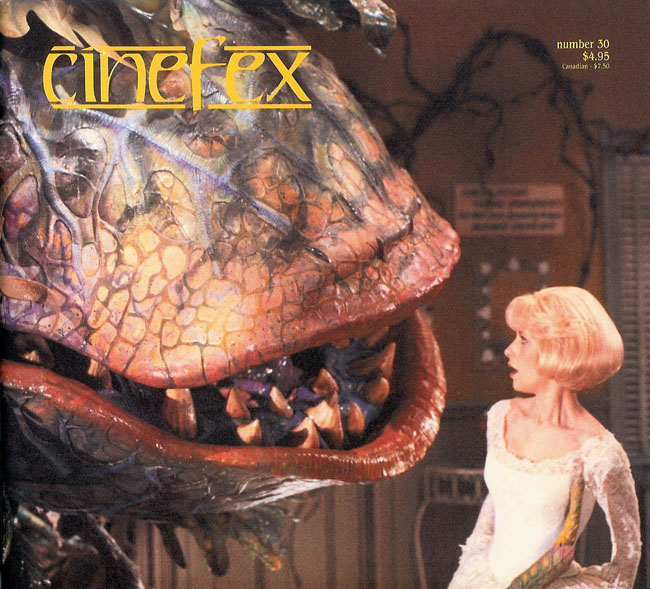
Little Shop of Horrors: The Care and Feeding of Audrey II: For someone with Lyle Conway's background, Little Shop of Horrors was a dream come true - and a nightmare. Enlisted by director Frank Oz to design and create a believable plant character that could hold its own in a multimillion dollar musical comedy, Conway and a crew of forty animatronics specialists rose to the challenge by producing six fully-articulated versions of Audrey II ranging in size from four-and-a-half inches to twelve-and-a-half feet - and then taught the largest three how to speak and sing. Article by Jody Duncan
The Gate: A Question of Perspective: Seeking major league effects on a minor league budget, producer John Kemeny and director Tibor Takacs turned to effects designer Randall William Cook for their supernatural thriller The Gate. Working with a hand-picked team of professionals, Cook orchestrated a wide range of mystifying effects - including a giant stop-motion demon and a swarm of devilish minions rendered tiny by some ingenious illusory techniques seldom employed in recent years. Article by Adam Eisenberg
The Golden Ghild: Of Daggers and Demons: For Industrial Light & Magic, The Golden Child was business as usual - winged demons, slithering snake women, even dancing Pepsi cans. But merging these fantasy elements into a gritty urban street comedy starring Eddie Murphy was a major stylistic challenge. Rising to the occasion was a team of software engineers and puppet animators who managed to blur the line between real and unreal by employing a prototype field motion control system to convincingly incorporate stop-motion figures into hand-held action scenes. Article by Paul Mandell
The Gate: A Question of Perspective: Seeking major league effects on a minor league budget, producer John Kemeny and director Tibor Takacs turned to effects designer Randall William Cook for their supernatural thriller The Gate. Working with a hand-picked team of professionals, Cook orchestrated a wide range of mystifying effects - including a giant stop-motion demon and a swarm of devilish minions rendered tiny by some ingenious illusory techniques seldom employed in recent years. Article by Adam Eisenberg
The Golden Ghild: Of Daggers and Demons: For Industrial Light & Magic, The Golden Child was business as usual - winged demons, slithering snake women, even dancing Pepsi cans. But merging these fantasy elements into a gritty urban street comedy starring Eddie Murphy was a major stylistic challenge. Rising to the occasion was a team of software engineers and puppet animators who managed to blur the line between real and unreal by employing a prototype field motion control system to convincingly incorporate stop-motion figures into hand-held action scenes. Article by Paul Mandell
Little Shop of Horrors: The Care and Feeding of Audrey II: For someone with Lyle Conway's background, Little Shop of Horrors was a dream come true - and a nightmare....
more

Issue 31
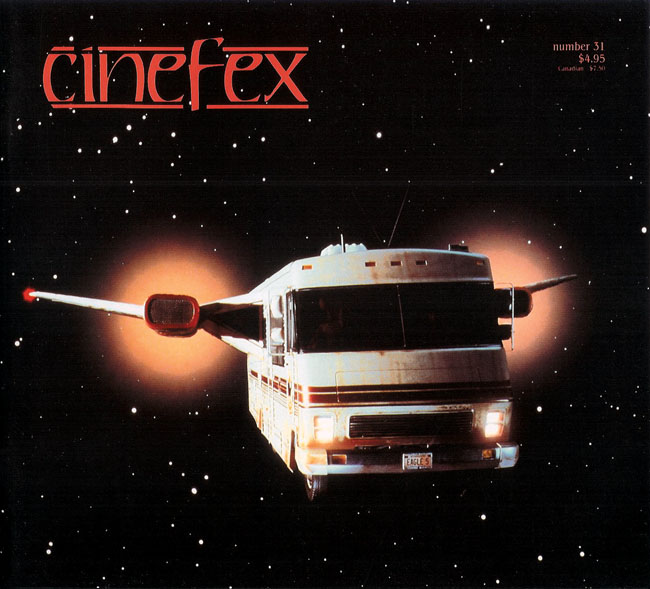
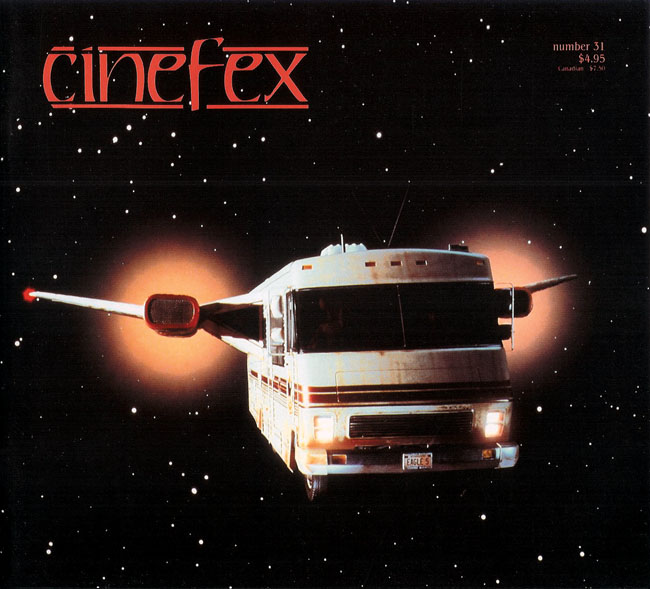
Spaceballs: Spaceballs - The Special Effects: In focusing his singular sense of humor on the science fiction film genre, Mel Brooks realized the ease with which he could have milked a few extra laughs by employing deliberately poor special effects. But instead, he wanted his parody to work within the context of a high-gloss production. To this end, he enlisted visual effects supervisor Peter Donen. Working primarily with Apogee - but with outside input from Illusion Arts and Industrial Light & Magic - Donen was able to orchestrate a full and varied array of cinematic illusions. Article by Mark Elliot
The Witches of Eastwick: Witch Trials: For director George Miller, The Witches of Eastwick was a formidable challenge - a supernatural comedy with a top-notch cast that required a deft touch to maintain its proper balance of humor and horror. Though effects would take a back seat in the production, it was necessary that they be brought to bear on such thorny problems as depicting a palatial mansion that did not exist, creating a tennis ball with a mind of its own and transforming actor Jack Nicholson into a fifty-foot demon. Engaged to accomplish these and other feats were Industrial Light & Magic and makeup effects artist Rob Bottin. Article by Adam Eisenberg
Masters of the Universe: Though derived from a phenomenally popular toy line, Masters of the Universe would prove to be anything but fun and games for production designer William Stout, visual effects supervisor Richard Edlund and makeup artist Michael Westmore. With high expectations but minimal time and resources, the design and effects teams had to translate plastic dolls into flesh-and-blood characters, create a faraway fantasy world from scratch and implant nonstop optical trickery into a sword-and-sorcery adventure of extravagant proportions. Article by Ron Magid
The Witches of Eastwick: Witch Trials: For director George Miller, The Witches of Eastwick was a formidable challenge - a supernatural comedy with a top-notch cast that required a deft touch to maintain its proper balance of humor and horror. Though effects would take a back seat in the production, it was necessary that they be brought to bear on such thorny problems as depicting a palatial mansion that did not exist, creating a tennis ball with a mind of its own and transforming actor Jack Nicholson into a fifty-foot demon. Engaged to accomplish these and other feats were Industrial Light & Magic and makeup effects artist Rob Bottin. Article by Adam Eisenberg
Masters of the Universe: Though derived from a phenomenally popular toy line, Masters of the Universe would prove to be anything but fun and games for production designer William Stout, visual effects supervisor Richard Edlund and makeup artist Michael Westmore. With high expectations but minimal time and resources, the design and effects teams had to translate plastic dolls into flesh-and-blood characters, create a faraway fantasy world from scratch and implant nonstop optical trickery into a sword-and-sorcery adventure of extravagant proportions. Article by Ron Magid
Spaceballs: Spaceballs - The Special Effects: In focusing his singular sense of humor on the science fiction film genre, Mel Brooks realized the ease with which he could have milked...
more

Issue 32

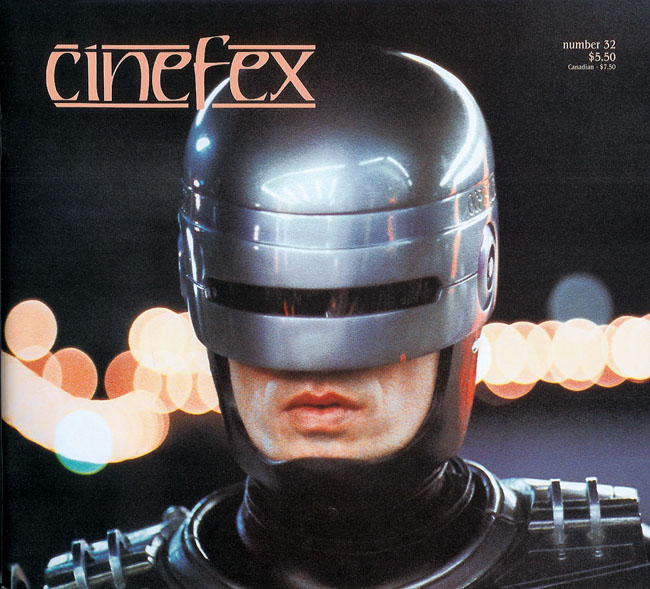
RoboCop: Shooting RoboCop: Big city crime has turned Old Detroit into a combat zone. Decent citizens can no longer venture forth onto the streets, day or night, and even police officers are prime targets for murder and mayhem. Clearly something must be done. The answer as proposed in Jon Davison's production of RoboCopis a new breed of urban crime-fighter - half man, half machine, all business. Engaged to create this cyborg superhero were film director Paul Verhoeven, actor Peter Weller and makeup effects artist Rob Bottin. Also contributing to the futuristic ambience were ED 209 supervisor Peter Kuran, matte artist Rocco Gioffre and a host of others who discuss in detail their experiences on this most explosive of box office hits. Article by Paul M. Sammon
Innerspace: Inside Martin Short: For most directors, getting inside one's characters is an intellectual exercise. But for Joe Dante, Innerspace represented a literal opportunity to explore on film the inner workings of a human being - specifically, supermarket clerk Jack Putter who, as a consequence of a miscarried microscopic submersible pod manned by test pilot Tuck Pendelton. Enlisted to design and produce the innespace footage was visual effects supervisor Dennis Muren of Industrial Light & Magic. Mixing anatomical realism with dramatic fancy, Muren and his associates produced both miniaturization effects and macroscopic excursions through the innermost recesses of actor Martin Short's eyes, ears, blood stream, stomach and lungs. Article by Janine Pourroy
Innerspace: Inside Martin Short: For most directors, getting inside one's characters is an intellectual exercise. But for Joe Dante, Innerspace represented a literal opportunity to explore on film the inner workings of a human being - specifically, supermarket clerk Jack Putter who, as a consequence of a miscarried microscopic submersible pod manned by test pilot Tuck Pendelton. Enlisted to design and produce the innespace footage was visual effects supervisor Dennis Muren of Industrial Light & Magic. Mixing anatomical realism with dramatic fancy, Muren and his associates produced both miniaturization effects and macroscopic excursions through the innermost recesses of actor Martin Short's eyes, ears, blood stream, stomach and lungs. Article by Janine Pourroy
RoboCop: Shooting RoboCop: Big city crime has turned Old Detroit into a combat zone. Decent citizens can no longer venture forth onto the streets, day or night, and even police...
more

1988
Issue 33

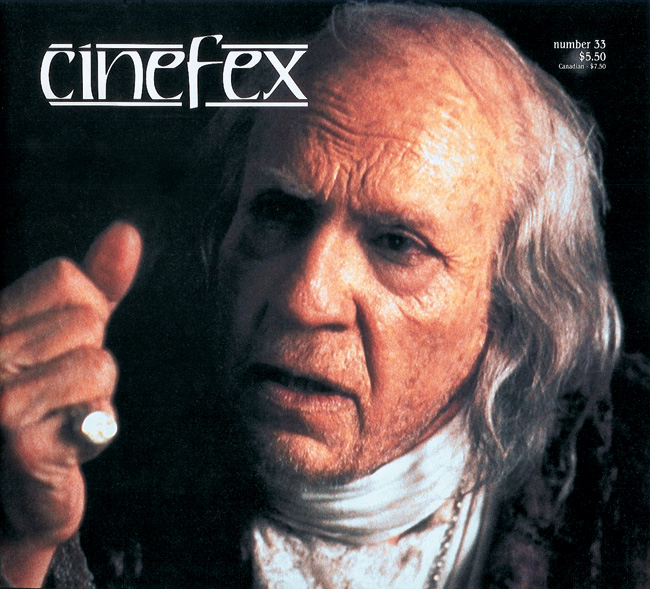
007 X 4 - John Richardson: In four of the last five James Bond adventures, special effects supervisor John Richardson has acted as an off-camera 'Q' to the indomitable 007 - engineering a speedboat chase over a waterfall in Moonraker; flying a minijet through an aircraft hanger in Octopussy, snaring a blimp on the Golden Gate Bridge in A View to a Kill and staging a massive ground and air battle in The Living Daylights. Eschewing opticals in favor of full-scale physical effects or cleverly integrated miniatures, Richardson has earned a reputation world-wide as an effects artisan of consummate ingenuity and skill. Article by Nora Lee
Aging Gracefully with Dick Smith: When a film script calls for an actor to age, one name comes quickly to mind - Dick Smith. In a celebrated career that has spanned more than forty years, Smith has designed and executed aging makeups for such classic films as Little Big Man, The Godfather, The Exorcist and Amadeus. Smith discusses in detail the evolution of old age makeup and gives an anecdotal account of his experiences adding years and decades to such motion picture notables as Dustin Hoffman, Marlon Brando and Walter Matthau. Article by Jody Duncan Shannon
The Predator: Predator Revealed: When producer Joel Silver went to R/Greenberg Associates with a script that called for an extraterrestrial being capable of rendering itself virtually invisible in the jungle, the challenge of creating such an effect - and others including it's thermographic vision - was eagerly accepted. By employing a red creature suit to generate mattes and a laborious optical technique for creating a multifaceted quasi-invisible figure, visual effects supervisor Joel Hynek and his crew were able to successfully render the alien in visual terms that were both effective and unique. Article by Paul Mandell
Aging Gracefully with Dick Smith: When a film script calls for an actor to age, one name comes quickly to mind - Dick Smith. In a celebrated career that has spanned more than forty years, Smith has designed and executed aging makeups for such classic films as Little Big Man, The Godfather, The Exorcist and Amadeus. Smith discusses in detail the evolution of old age makeup and gives an anecdotal account of his experiences adding years and decades to such motion picture notables as Dustin Hoffman, Marlon Brando and Walter Matthau. Article by Jody Duncan Shannon
The Predator: Predator Revealed: When producer Joel Silver went to R/Greenberg Associates with a script that called for an extraterrestrial being capable of rendering itself virtually invisible in the jungle, the challenge of creating such an effect - and others including it's thermographic vision - was eagerly accepted. By employing a red creature suit to generate mattes and a laborious optical technique for creating a multifaceted quasi-invisible figure, visual effects supervisor Joel Hynek and his crew were able to successfully render the alien in visual terms that were both effective and unique. Article by Paul Mandell
007 X 4 - John Richardson: In four of the last five James Bond adventures, special effects supervisor John Richardson has acted as an off-camera 'Q' to the indomitable 007...
more

Issue 34
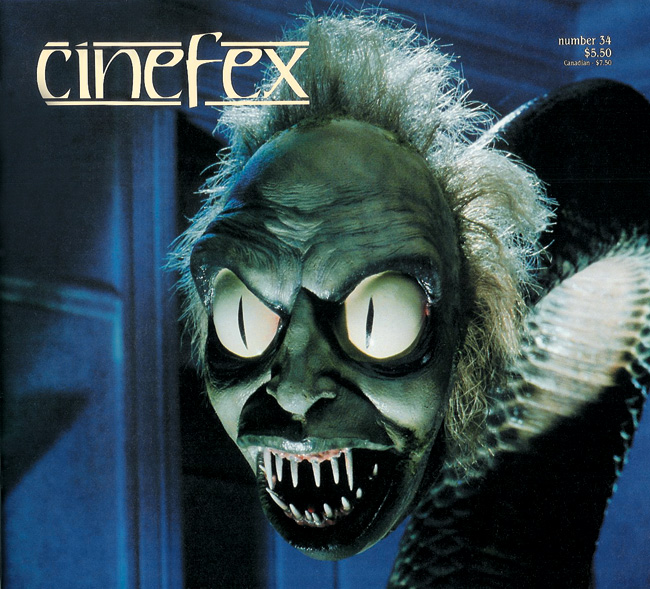
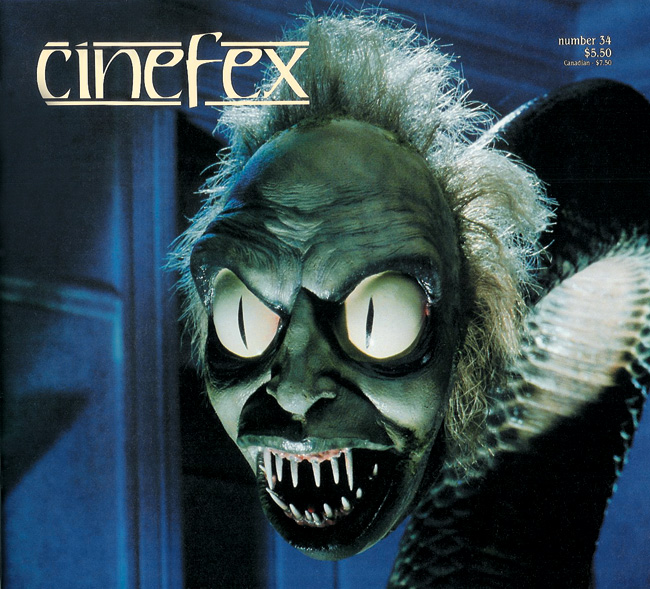
Beetlejuice: Cheap and Cheesy and Off-the-Cuff: To produce a wildly offbeat supernatural comedy with wall-to-wall effects and limited funding, Beetlejuice director Tim Burton turned to first-time visual effects supervisor Alan Munro who assembled a choice team of cost-conscious independents willing and able to conjure up hundreds of effects shots for a very small portion of the film's $14 million budget. In charge of creature creation and makeup illusions was principal effects contractor Robert Short; providing opticals and miniature support was Peter Kuran of Visual Concept Engineering; and tasked with enlivening three highly specialized animation sequences were Doug Beswick, Ted Rae and Tim Lawrence. Together they assembled the fanciful imagery that helped make Beetlejuice the first big hit of the summer season. Article by Jody Duncan Shannon
Batteries Not Included: Visit from a Small Planet: When Amblin Entertainment brought Batteries Not Included to Industrial Light & Magic, visual effects supervisor Bruce Nicholson found the prospect of creating a family of pint-size anthropomorphic flying saucers both intriguing and challenging. Principal among the challenges was the need to create ships that could be photographed in real time on live-action sets and also in bluescreen environments under motion control. Most importantly, the imagery produced through employment of these two techniques had to be stylistically indistinguishable even when cut together end to end. Developed to support the effort was a sophisticated new wire rig and a winning array of flying machines brought to life via overhead wires, motion control, rod puppetry, stop-motion animation and go-motion. Article by Richard Linton
Batteries Not Included: Visit from a Small Planet: When Amblin Entertainment brought Batteries Not Included to Industrial Light & Magic, visual effects supervisor Bruce Nicholson found the prospect of creating a family of pint-size anthropomorphic flying saucers both intriguing and challenging. Principal among the challenges was the need to create ships that could be photographed in real time on live-action sets and also in bluescreen environments under motion control. Most importantly, the imagery produced through employment of these two techniques had to be stylistically indistinguishable even when cut together end to end. Developed to support the effort was a sophisticated new wire rig and a winning array of flying machines brought to life via overhead wires, motion control, rod puppetry, stop-motion animation and go-motion. Article by Richard Linton
Beetlejuice: Cheap and Cheesy and Off-the-Cuff: To produce a wildly offbeat supernatural comedy with wall-to-wall effects and limited funding, Beetlejuice director Tim Burton turned to first-time visual effects supervisor Alan...
more

Issue 35
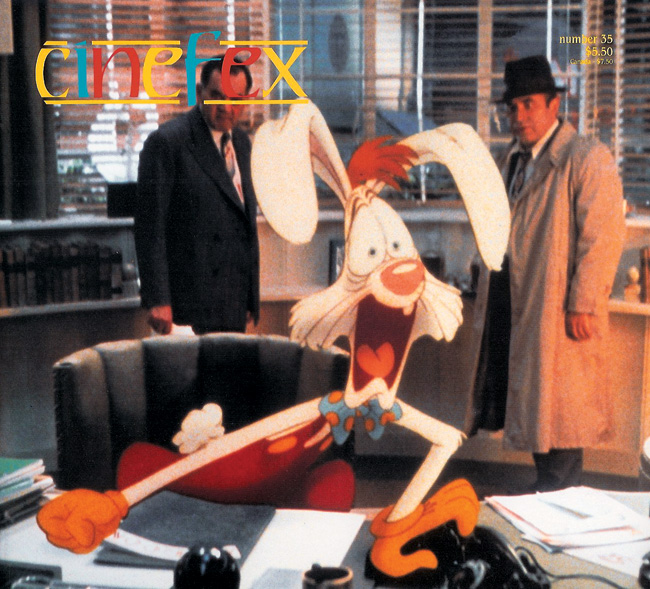
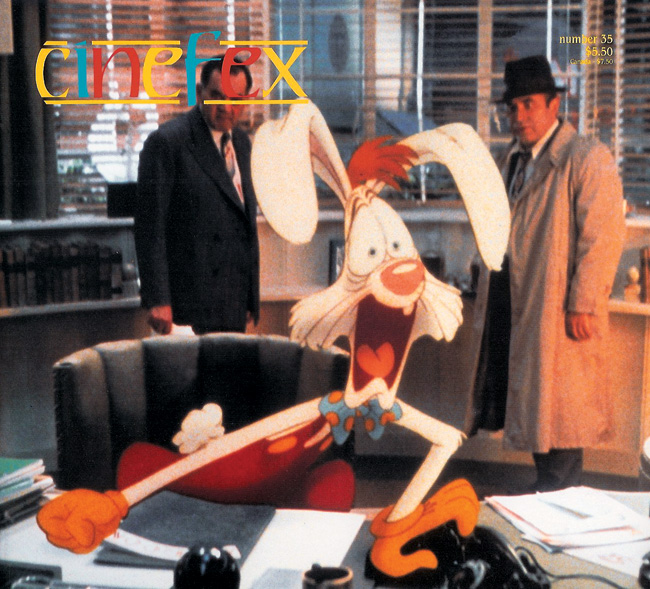
Who Framed Roger Rabbit?: Romancing the Rabbit: What if cartoon characters were real performers who lived and breathed and worked on movie soundstages like any other actor? With the considerable might of Walt Disney Studios and Amblin Entertainment behind him, director Robert Zemeckis took that offbeat notion and from it concocted Who Framed Roger Rabbit - a frenetic comedy adventure combining live-action and animation with a degree of realism never before attempted. Mechanical effects by George Gibbs and Michael Lantieri enabled actor Bob Hoskins and others to interact convincingly with characters that had no on-set presence. These characters were later provided by some three hundred artisans working under animation director Richard Williams and were then seamlessly integrated into the live-action -complete with shadows and highlights - by the optical wizards at Industrial Light & Magic. Article by Adam Eisenberg
Willow: Filmmaking impresario George Lucas - whose flights of fancy have spawned the Star Wars trilogy and the adventures of Indiana Jones - has focused on myth and magic for his latest excursion into the world of unbridled imagination. Manufacturing an earthbound environment every bit as wondrous and complete as Tatooine or Endor, Lucas and film director Ron Howard have produced Willow - an epic sword-and-sorcery adventure complete with fairy princesses, evil queens, firebreathing dragons, pesky brownies, talking animals and a diminutive hero determined to save an infant foundling from the forces of evil. Willow represents the most complete mustering of Lucasfilm effects talent since Return of the Jedi - employing effects animation, miniaturization techniques, stop-and-gomotion, animatronics and computer generated imagery. Article by Jody Duncan Shannon
Willow: Filmmaking impresario George Lucas - whose flights of fancy have spawned the Star Wars trilogy and the adventures of Indiana Jones - has focused on myth and magic for his latest excursion into the world of unbridled imagination. Manufacturing an earthbound environment every bit as wondrous and complete as Tatooine or Endor, Lucas and film director Ron Howard have produced Willow - an epic sword-and-sorcery adventure complete with fairy princesses, evil queens, firebreathing dragons, pesky brownies, talking animals and a diminutive hero determined to save an infant foundling from the forces of evil. Willow represents the most complete mustering of Lucasfilm effects talent since Return of the Jedi - employing effects animation, miniaturization techniques, stop-and-gomotion, animatronics and computer generated imagery. Article by Jody Duncan Shannon
Who Framed Roger Rabbit?: Romancing the Rabbit: What if cartoon characters were real performers who lived and breathed and worked on movie soundstages like any other actor? With the considerable...
more

Issue 36

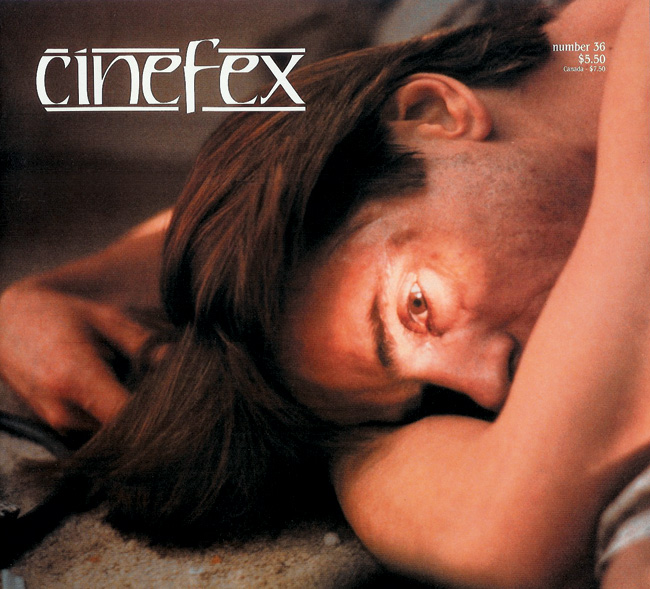
Alien Nation: A Planetful of Aliens: To fulfill a need for hundreds of extraterrestrial characters - ranging from principal players to incidental extras - the producers of Alien Nation turned to Stan Winston Studios. There - under the direction of Alec Gillis, Shane Mahan, John Rosengrant and Tom Woodruff Jr., with on-set collaboration by Zoltan Elek - was mounted the largest makeup effects show in twenty years. Article by Ron Magid
Die Hard: Exaggerated Reality: Even with near-total access to a brand new high-rise building, the makers of Die Hard needed something more to bring their action thriller to the screen. To simulate a bomb blast in an elevator shaft and a giant rooftop explosion and helicopter crash, producer Joel Silver enlisted the services of visual effects producer Richard Edlund and his Boss Film Corporation. Article by Adam Eisenberg
Dead Ringers: Double Vision: On Dead Ringers - the latest chiller by horror impresario David Cronenberg - optical effects supervisor Lee Wilson worked with Balsmeyer and Everett and Film Effects of Toronto to create a new generation of split-screen opticals that enabled actor Jeremy Irons to play scenes with himself as twin brothers without the customary restriction of stationary splits or even locked-off cameras. Article by Don Shay
The Blob: The Right Blob for the Right Job: For his updated remake of The Blob, director Chuck Russell engaged visual effects production supervisor Michael Fink to oversee an outpouring of cinematic illusions that included gooey creature effects by Lyle Conway and Stuart Ziff, special makeup creations by Tony Gardner and opticals and miniature photography by Hoyt Yeatman and Dream Quest Images. Article by Robert G. Pielke
Die Hard: Exaggerated Reality: Even with near-total access to a brand new high-rise building, the makers of Die Hard needed something more to bring their action thriller to the screen. To simulate a bomb blast in an elevator shaft and a giant rooftop explosion and helicopter crash, producer Joel Silver enlisted the services of visual effects producer Richard Edlund and his Boss Film Corporation. Article by Adam Eisenberg
Dead Ringers: Double Vision: On Dead Ringers - the latest chiller by horror impresario David Cronenberg - optical effects supervisor Lee Wilson worked with Balsmeyer and Everett and Film Effects of Toronto to create a new generation of split-screen opticals that enabled actor Jeremy Irons to play scenes with himself as twin brothers without the customary restriction of stationary splits or even locked-off cameras. Article by Don Shay
The Blob: The Right Blob for the Right Job: For his updated remake of The Blob, director Chuck Russell engaged visual effects production supervisor Michael Fink to oversee an outpouring of cinematic illusions that included gooey creature effects by Lyle Conway and Stuart Ziff, special makeup creations by Tony Gardner and opticals and miniature photography by Hoyt Yeatman and Dream Quest Images. Article by Robert G. Pielke
Alien Nation: A Planetful of Aliens: To fulfill a need for hundreds of extraterrestrial characters - ranging from principal players to incidental extras - the producers of Alien Nation turned...
more

1989
Issue 37

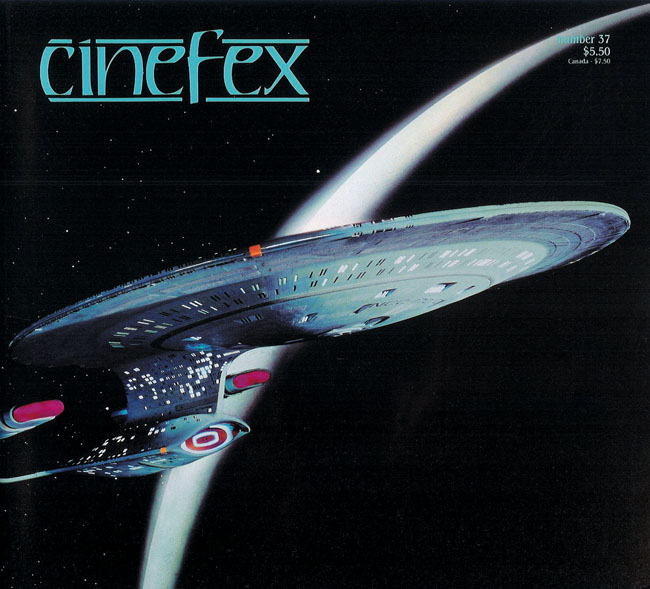
Star Trek: The Next Generation: Special Effects - The Next Generation: The issue of visual effects had to be addressed early in the planning stages for Star Trek - The Next Generation. With fifty or more quality effects shots needed for each weekly episode - and only a modicum of time and money to spend on them - an alternative to film opticals was considered essential. Aware of advances in video effects technology, the producers turned to two of the most progressive video postprodiction companies in the business - The Post Group and Composite Image Systems - to take them where no television series had gone before. Article by Glenn Campbell and Donna Trotter
The Fly II: On The Fly - The Making of a Sequel: At the end of David Cronenberg's horror hit, The Fly, Veronica Quaife is left pregnant with the child of Seth Brundle, uncertain of what effect the mutant housefly genes that destroyed her lover might have on their child. First-time director Chris Walas - who as makeup effects supervisor had won an Oscar for the first film - was given an opportunity to explore the possibilities in The Fly II. Reuniting key members of his makeup and effects unit for the sequel, Walas translated onto film the physical metamorphosis of young Martin Brundle from normal human being to murderours mutant insect. Article by Robin Brunet
From Science to Showbiz: In a serendipitous merging of skills, equipment and opportunity, Oxford Scientific Films was founded by a group of university zoologists intent upon photo-documenting the microscopic wonders of the world surrounding them. Before long, the fresh perspective they brought to motion picture problem solving led to their involvement in a variety of feature film projects. Today - expanded into a full-service facility - Oxford Scientific is a respected leader among British effects studios. Article by Pamela Duncan Looft
The Fly II: On The Fly - The Making of a Sequel: At the end of David Cronenberg's horror hit, The Fly, Veronica Quaife is left pregnant with the child of Seth Brundle, uncertain of what effect the mutant housefly genes that destroyed her lover might have on their child. First-time director Chris Walas - who as makeup effects supervisor had won an Oscar for the first film - was given an opportunity to explore the possibilities in The Fly II. Reuniting key members of his makeup and effects unit for the sequel, Walas translated onto film the physical metamorphosis of young Martin Brundle from normal human being to murderours mutant insect. Article by Robin Brunet
From Science to Showbiz: In a serendipitous merging of skills, equipment and opportunity, Oxford Scientific Films was founded by a group of university zoologists intent upon photo-documenting the microscopic wonders of the world surrounding them. Before long, the fresh perspective they brought to motion picture problem solving led to their involvement in a variety of feature film projects. Today - expanded into a full-service facility - Oxford Scientific is a respected leader among British effects studios. Article by Pamela Duncan Looft
Star Trek: The Next Generation: Special Effects - The Next Generation: The issue of visual effects had to be addressed early in the planning stages for Star Trek - The...
more

Issue 38

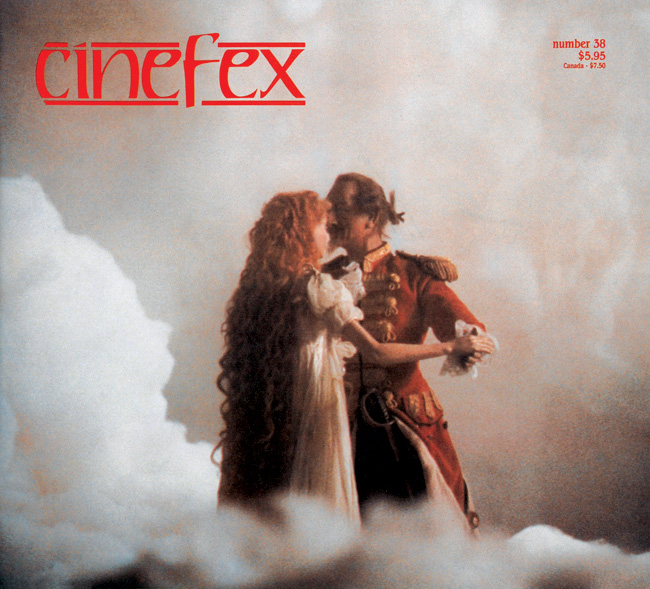
The Adventures of Terry Gilliam: While thematic similarities resonate through the collected works of all visionary artists, even the most self-aware amongst them might be hesitant to proclaim as a trilogy three decisively unique film projects unrelated in time and place and without a single character in common. Not so Terry Gilliam. For him, Time Bandits, Brazil and The Adventures of Baron Munchausen represent a three-part celebration of the persistent dreamer seeking refuge in flights of fancy from the humdrum realities of the workaday world. With massive doses of imagination - and an irreverent sense of humor springing from his Monty Python roots - Gilliam has spent the last decade leaping through time and space and into alternate universes both wondrous and bizarre. Acutely aware that special effects are the essential elements needed to unlock his wildest imaginings, Gilliam has surrounded himself with top practitioners in the field -some spanning all three pictures - who have consistently pushed the limits of budget-conscious, low-tech film trickery to produce for him an abundance of cinematic wonders both grand and small. Article by Paul M. Sammon and Don Shay
The Adventures of Terry Gilliam: While thematic similarities resonate through the collected works of all visionary artists, even the most self-aware amongst them might be hesitant to proclaim as a...
more

Issue 39

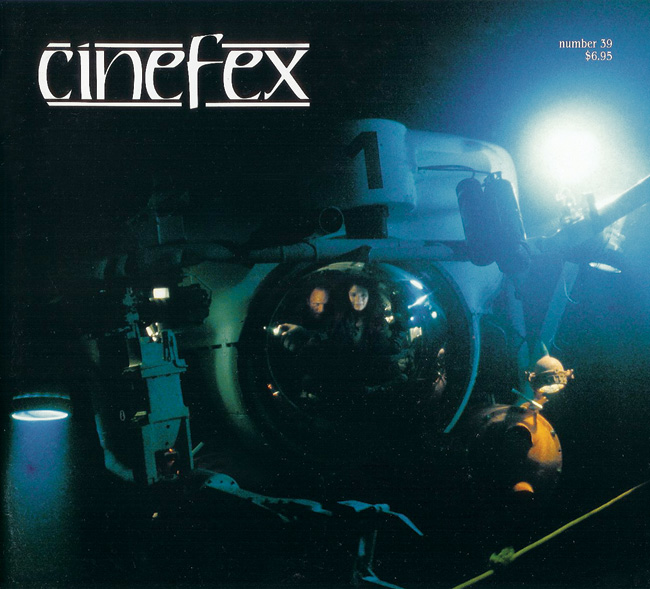
The Abyss: Dancing on the Edge of the Abyss: Writer-director James Cameron and producer Gale Anne Hurd have carved a distinct niche for themselves in the world of high-tech science fiction filmmaking. After traveling across time in The Terminator and to the outer reaches of deep space in Aliens, they have now journeyed into the Cayman Trough - one of the deepest and most impenetrable chasms on earth - for The Abyss, Set in an underwater oil drilling habitat located seventeen hundred feet beneath the ocean surface, the film begins with the search for a downed nuclear submarine and evolves into an aquatic odyssey of cosmic consequence. Forty percent of the production was shot in the largest fresh water filming tank in the world - a specially converted reactor containment building located at an uncommissioned nuclear power plant. Nine visual effects units were engaged to produce literally hundreds of shots covering the gamut of cinematic illusions from computer generated imagery and motion control to animatronic puppets and radio control vehicles to matte paintings and underwater miniatures to rear projection and bluescreen traveling mattes. Virtually no effects technique was left untapped. A trio of distinguished effects supervisors - John Bruno and Hoyt Yeatman and Dennis Muren - oversaw the activities of in-house units and teams from Dream Quest Images and Industrial Light & Magic. Ancillary units were headed by Cameron veterans Robert and Dennis Skotak and Gene Warren of Fantasy II. Though photographed thousands of miles apart - in situations both wet and dry and by artists of diverse talents and experience - the effects blended together seamlessly with the main unit photography and with one another. The end result is an unprecedented and uncompromising accomplishment - an epic film of wonder and imagination propelled by the singular vision and relentless drive of a master filmmaker just hitting his stride. Article by Don Shay
The Abyss: Dancing on the Edge of the Abyss: Writer-director James Cameron and producer Gale Anne Hurd have carved a distinct niche for themselves in the world of high-tech science...
more

Issue 40

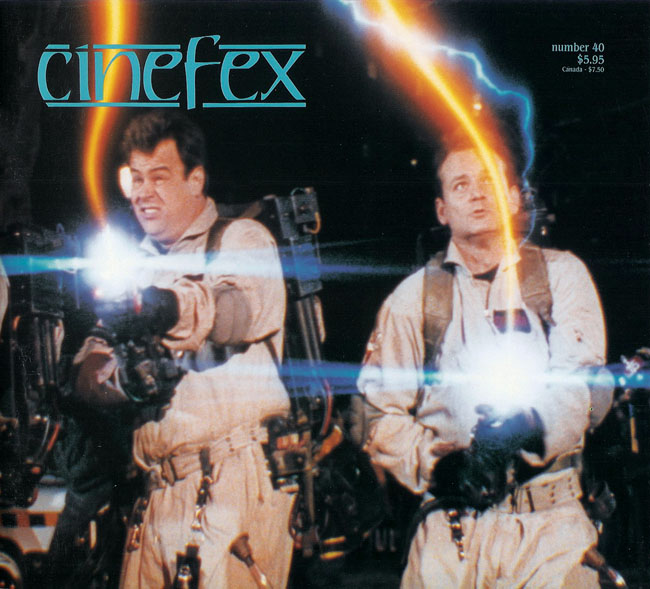
Ghostbusters II: Ghostbusters Revisited: With Ghostbusters, producer-director Ivan Reitman and company performed a minor miracle by delivering a major effects production in less than a year - from concept to release. The result was the most successful comedy in film history. For the sequel - five years later - production and postproduction schedules were even more intense. Physical effects engineer Chuck Gaspar was on hand for his second Ghostbusters outing and Industrial Light & Magic stepped in fresh to handle the visual effects - delivering not only a full array of ghostly entities, but also a subterranean river of slime and an ambulatory Statue of Liberty. As the production continued to grow, other effects facilities - including Apogee - were brought in to absorb the over-flow. Effects team members across the spectrum - augmented by screenwriting actors Dan Aykroyd and Harold Ramis - trace the evolution and execution of the long-awaited Ghostbusters II. Article by Adam Eisenberg
Indiana Jones and the Last Crusade: Father, Son and the Holy Grail: When director Steven Spielberg and producer George Lucas joined forces to reinvent in feature form the action-packed movie serials of the past, their stylish embellishment proved a boxoffice phenomenon - from a pair of filmmakers accustomed to making little else. Eight years and three films into the series, the saga of Indiana Jones culminates with Indiana Jones and the Last Crusade - a rousing finale in which the intrepid archaeologist's past is explored and his relationship with his father reinstated. Filmed in seven countries on three continents, the massive production relied heavily on physical and optical effects to recreate nearly every mode of transportation known to the period. Also required was the full disintegration of a major character - from flesh to dust - in one uninterrupted take. Rising to the challenge were physical effects technicians under George Gibbs and the optical illusionists at Industrial Light & Magic. Article by Adam Eisenberg
Indiana Jones and the Last Crusade: Father, Son and the Holy Grail: When director Steven Spielberg and producer George Lucas joined forces to reinvent in feature form the action-packed movie serials of the past, their stylish embellishment proved a boxoffice phenomenon - from a pair of filmmakers accustomed to making little else. Eight years and three films into the series, the saga of Indiana Jones culminates with Indiana Jones and the Last Crusade - a rousing finale in which the intrepid archaeologist's past is explored and his relationship with his father reinstated. Filmed in seven countries on three continents, the massive production relied heavily on physical and optical effects to recreate nearly every mode of transportation known to the period. Also required was the full disintegration of a major character - from flesh to dust - in one uninterrupted take. Rising to the challenge were physical effects technicians under George Gibbs and the optical illusionists at Industrial Light & Magic. Article by Adam Eisenberg
Ghostbusters II: Ghostbusters Revisited: With Ghostbusters, producer-director Ivan Reitman and company performed a minor miracle by delivering a major effects production in less than a year - from concept to...
more
